
Many organisations have a document they call a contingency plan. Far fewer could say when the people named in it (if it exists to that level of detail) last practised what it asks of them. This article is about that gap, and about how a tabletop exercise closes it by building the team behind the plan.
What contingency planning is
Contingency Planning is a proactive process of thinking about and preparing for the moment that Plan A has to become Plan B. It is about being ready for outcomes other than the one you expected. Some contingency planning is focussed on minimising the impact of one alternative outcome, as part of risk management, but resilience (the ability to recover and the pace an organisation can do it) is well-served by a broader approach to contingency planning, which puts in place the teamwork, processes and agility to confidently deal with the unexpected.
Mike Tyson’s line applies: everyone has a plan until they get punched in the mouth. Contingency planning is the work of deciding, before the punch lands, what the organisation does next.
What it is not
Contingency Planning is unlikely to be delivered through a document, a flow chart or even a single exercise or rehearsal. While consultants can help, effective contingency planning is about teams, culture and timely decision making within the organisation, and needs engagement from top to bottom. Any activity which is motivated by the need to tick a compliance box is very unlikely to deliver any meaningful contribution.
The compliance box has a close relative, which is exercise theatre: the rehearsal whose purpose is to be seen to have happened. Senior people attend, a scenario is read out, the plan is confirmed to work and a line goes in the annual report. Nobody had to decide anything under pressure, so nothing about the team or the process has been challenged or changed. An exercise of that kind is a performance, and has more impact in the Annual Report than on the day everything goes wrong.
The underpinning theory
Charles Perrow made the uncomfortable case, in Normal Accidents, that in complex, tightly coupled systems some failures are built in, and no amount of design removes them. Once that is conceded, the case for resilience is simple. If some failures will happen whatever you do, the capacity to recover from them deserves at least as much attention as the effort spent preventing them. In risk management terms, we are much more interested in minimising and mitigating impact, rather than managing away likelihood.
Aaron Wildavsky drew the line that matters most to us, in Searching for Safety, between anticipation and resilience. His argument is that anticipation tries to predict specific harms and prevent them in advance, while resilience builds the capacity to cope with harms as they actually arrive. A thick plan written against a ranked list of predicted risks fits in the anticipation category and Wildavsky’s warning is that an organisation heavily invested in dealing with specific predictions becomes brittle when the unexpected turns up. Our focus is on resilience, building the capacity to handle whatever arrives.
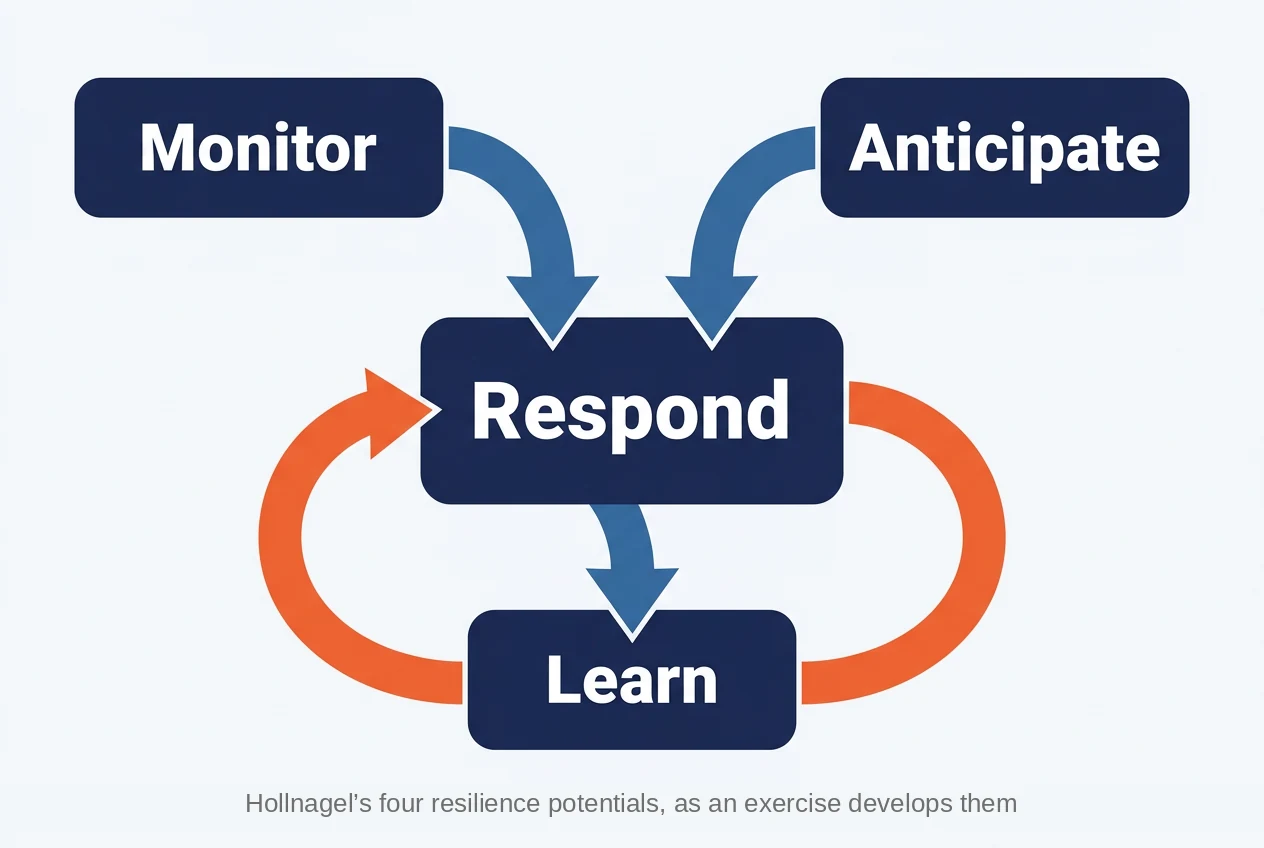
Erik Hollnagel’s work provides a useful model for thinking about what a resilient organisation needs to be able to do in order to flex from normal operations into a crisis and back. He first called them the four abilities of resilient performance, and later the four potentials: the organisation can respond to what is happening, monitor what is developing, anticipate what could happen, and learn from what has happened. Karl Weick and Kathleen Sutcliffe reached a similar place in Managing the Unexpected from the study of high-reliability organisations, whose defining habits include a preoccupation with failure, a reluctance to simplify what they see and a willingness to let expertise rather than rank decide in the moment. The common thread is that resilience is a set of practised capabilities deliverable by teams, with anticipation only one component in four. Anticipation on its own, in Wildavsky’s sense, breeds fragility; Hollnagel builds on him by making it one potential among four, where anticipating is thinking about what might happen and monitoring is looking for the indicators and warnings that it is starting to.
Four potentials, one rehearsal
An exercise practises a response. Updates arrive, the information is incomplete or wrong, and the people round the table have to collaborate, confer, communicate and compromise while the clock runs. Those four behaviours are what the exercise exists to develop, and a performance cannot reach them.
Within that response, an effective team learns the other three potentials. It learns to monitor the ongoing situation, watching for specific indicators and warnings, for expected news that fails to appear, and for the assumption that is now carrying the whole plan. It learns to anticipate, because every time the team feels balanced and ahead of the curve, the facilitator asks them what new contingencies they could be aiming off against. It learns through iteration and the after action review: the debrief turns the experience into knowledge, and the next exercise tests whether the knowledge stuck.
The plan stays on the table throughout and it is useful, but the exercise is rehearsing the team.
What a good tabletop exercise looks like
We design exercises to develop individuals and teams into an effective decision-making staff. Iterative progress is important, to develop confidence alongside competence. We start by building the Knowledge and Skills to be able to function in an uncertain environment, but once a team understands that mistakes are opportunities to learn and has understood those basics, we can develop really effective Behaviours through iterative, simulated Experience. By making sure reflection happens after every episode, we can stretch learners from a standing start to a realistic scenario in which they are not just dealing with external friction and internal tension, but also a red player, actively trying to push them off balance with anything from unhelpful narratives to opportunistic criminal activity. In the current geopolitical climate, this player could even reflect an adversarial foreign power.
The red player offers more than just friction. Weather, a failed supplier or a dead phone line are the environment; a red player is an adversary with intent. Many organisations have rehearsed against the first set and few against the second. Each episode runs the team round Kolb’s cycle, from the experience through reflection to the principle and the next attempt, which is the mechanism experiential learning depends on. Knowledge, Skills, Experience and Behaviours are the four things a learning and development budget can actually change, and a table-top exercise designed this way moves all four. A script rehearsed as written moves the first, at best.
This is also why one exercise is rarely enough. The first pass shows a team where it has room to improve; the second, run against a harder scenario a few months later, provides the opportunity to show development. A programme of exercises that gets progressively more demanding is what enables a more resilient organisation.
Where contingency planning goes wrong
Sidney Dekker, in Drift into Failure, describes how organisations drift into failure through a long series of small, locally sensible decisions, each one a little further from the margin. In contingency planning the same pattern looks more like erosion. The plan is written after an incident, exercised once while the memory is fresh, and then updated on a schedule by people who have never executed it. Three years on, the document is current and the capability has gone. Nobody decided that; it eroded, one reasonable postponement at a time, and the review cycle that kept the paperwork tidy gave no signal that anything was wrong.
The second pathology is compliance over competence. ISO 22301, the business continuity standard, requires at clause 8.5 a programme of exercising and testing: exercises consistent with the scope and objectives of the continuity system, built on appropriate scenarios, run at planned intervals and after significant change, and written up in formal post-exercise reports. ISO 22398, the companion guidance on exercises, lists tabletop exercises among the discussion-based methods. Clause 8.6 of 22301 then requires the organisation to evaluate its continuity documentation and capabilities. It is the part of the standard where paper-only programmes fail most visibly under audit, because an auditor can easily tell the difference between an exercise that was actually run and one that was just talked about. We do the exercising. Certification is a separate job for a separate provider. The standard is useful here because it states, as an obligation, what we would argue from experience: a plan nobody has actually exercised is just an aspiration. What separates an exercise that finds something from one that only confirms the plan is covered in what good business continuity testing looks like.
Planning for contingency, not a contingency
The plan is still worth writing. It allocates responsibilities, it records what has already been decided and it gives the team a script to depart from when the situation demands it. Achieving the best outcome depends on the people named in it having practised deciding together, under pressure, against someone trying to make them fail, and then sat down afterwards to work out what they would do differently. That is contingency planning as a genuine capability, and it is what a TTX run properly builds.
If your decision making teams have not done something like this recently, a facilitated scenario-based exercise is the fastest way to find out whether your team can move from Plan A to Plan B when it has to. Get in touch and we will design one around the decisions your organisation would actually have to make.
Frequently asked questions
What is contingency planning?
Contingency planning is the process of preparing for outcomes other than the one you expected, so that when Plan A stops working the organisation already knows how it will move to Plan B. Done well it is a capability held by a team and developed through rehearsal.
How is contingency planning different from business continuity planning?
Business continuity planning is usually the formal, documented discipline of keeping critical functions running through disruption, often structured around a standard such as ISO 22301. Contingency planning, as we use the term, is the wider posture that business continuity sits inside: the readiness of the people and the culture to decide and adapt when the situation departs from any plan. A business continuity plan that has never been exercised is contingency planning in name only.
What is a tabletop exercise?
A tabletop exercise is a facilitated, discussion-based rehearsal in which a team works through a realistic scenario around a table, making the decisions they would have to make in a real event. The best versions add friction, time pressure and a red player who is actively trying to make the team fail, and finish with a structured debrief so that the experience turns into learning.
How often should a contingency plan be exercised?
At least annually, and after any significant change to the organisation, its systems or its people. The frequency matters less than the progression: a series of exercises that builds from the basics to a demanding scenario develops the team, where a single annual walk-through mostly confirms that the document still exists.