
Leadership is not a trait you either have or you don’t. It is a skill you build through practice. And like most skills, it develops faster when the practice is deliberate, realistic and grounded in the actual decisions leaders need to make.
For small and medium-sized businesses, this creates a genuine challenge. Off-the-shelf leadership programmes are designed for large organisations with dedicated L&D budgets. Generic workshops teach principles, but rarely give participants the chance to apply them under any meaningful pressure. The result is leaders who understand the theory and still hesitate to make decisions when it matters.
Leadership games change that equation. By placing participants in realistic scenarios that demand strategic thinking, communication and fast decision-making, they create conditions where leadership skills are not just discussed but developed. It is experiential learning applied to leadership.
What leadership games actually involve
The term leadership game covers a wide range of formats, but the underlying logic is consistent. Participants are placed in a scenario with objectives, constraints, incomplete information and time pressure. They have to make decisions, coordinate with others, adapt when things change, and account for the consequences of their choices.
That combination sits at the heart of what leadership actually demands. The scenario can be tailored to any sector or challenge: a business facing a reputational crisis, a team managing a complex project under competing priorities, a leadership group navigating an organisational change. The game design wraps your real situation in a structured exercise that is safe to fail in, which means participants can take risks, make mistakes and learn from them without the consequences having detrimental impact in the real world.
How tabletop exercises support strategic training
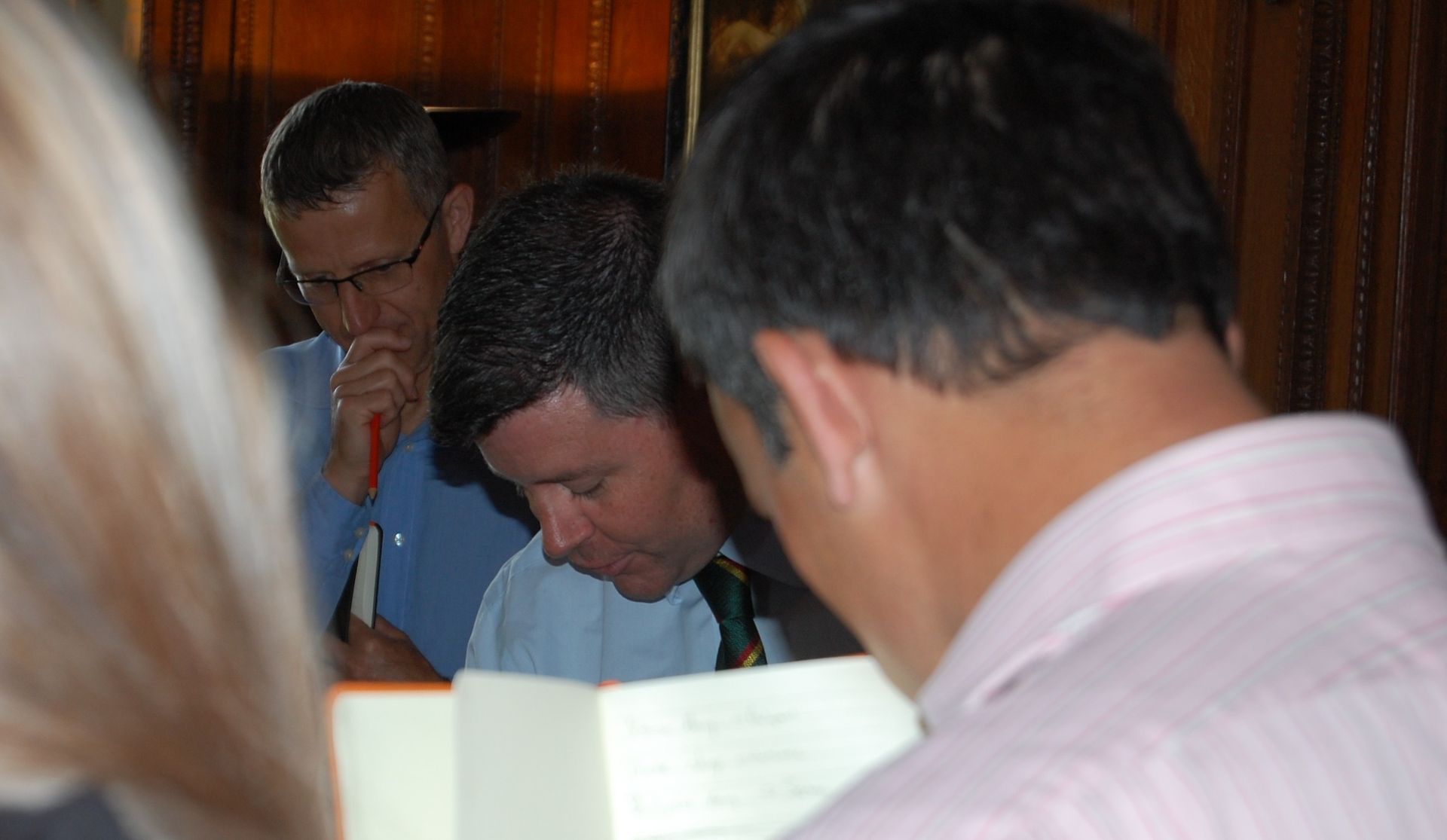
A tabletop exercise is one of the most versatile formats available for leadership and strategic training. Participants work through a specific scenario at a table (or virtually), responding to events as they unfold, discussing options and making decisions as a group. The facilitator introduces complications, conflicting information and escalating pressure. The exercise reveals how the team thinks, communicates and makes decisions together.
For small business team building, the tabletop format has particular advantages. It requires no specialist equipment or large venue. It can be designed around your actual plans and priorities. And it surfaces the specific dynamics of your actual team rather than producing generic outputs that don’t quite fit.
What leaders typically discover through tabletop exercises is not what they expected to find. The gaps are rarely where they assumed. A team that functions well in its day-to-day might fragment when asked to make decisions under time pressure, or when roles and authority are ambiguous. A leadership group that agrees on the strategy might diverge sharply on how to implement it when a scenario forces them to prioritise. That kind of insight is difficult to generate in any other way.
Decision making scenarios: building the muscle
Decision-making under pressure is a learnable capability. The cognitive science is clear: leaders and teams who have experienced a situation in simulation perform better when the real version occurs. Decision making scenarios work because they build the mental models that support good performance when it counts.
For small businesses, this is particularly valuable. A company with ten people cannot afford a leadership team that freezes in a crisis or defaults to a single decision-maker under pressure. Scenario based games develop the distributed decision-making capability and empowerment that makes organisations genuinely resilient. Participants learn to read a situation quickly, communicate their assessment clearly, coordinate with others who have different information and priorities, and commit to a course of action despite uncertainty.
That is strategic training in the truest sense. Not strategy as a presentation on a screen, but strategy as something the leadership team has practised executing together.
Why bespoke matters for small business team building
One common objection to leadership games is that they feel artificial. The scenario doesn’t quite fit. The roles don’t match how the team actually works. The pressures in the game are not the pressures the business actually faces.
This is a real risk with off-the-shelf products. It is not a risk with bespoke design. Evocatus builds every exercise around the specific organisation, team and challenge in front of us. That means the scenario reflects your sector, your actual plans and the specific leadership decisions your people will need to make. The result is an exercise that feels real because it is built from real material; it’s a rehearsal for something that could actually happen.
For small businesses, bespoke design is not a luxury. It is what makes the exercise worth doing.
Why Evocatus
Evocatus Consulting brings together decades of expertise in exercise design, facilitation and scenario-based learning. Our work spans defence, financial services, local government and commercial risk-management sectors. We design and deliver leadership games, tabletop exercises and scenario based games that produce specific, actionable insight rather than general reassurance.
Every engagement begins with understanding what you need to achieve. The exercise is built around that objective. The facilitation ensures participants are stretched without being overwhelmed, and the debrief translates what happened in the scenario into what it means for your organisation.
If you want your leadership team to practice the decisions that matter before those decisions arrive for real, we can help.
Get in touch at evocatus.co.uk to discuss what a bespoke leadership exercise could do for your team.