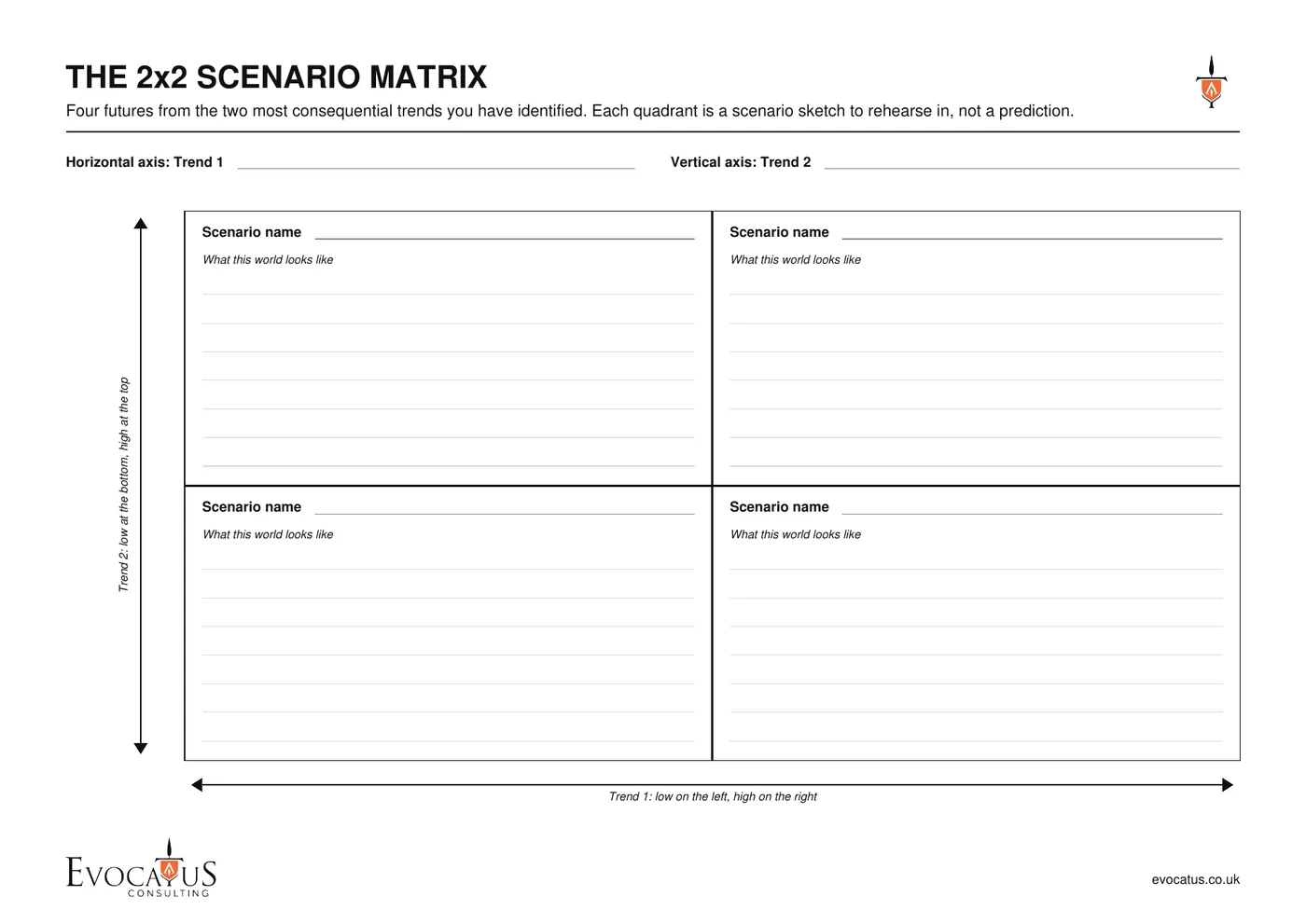
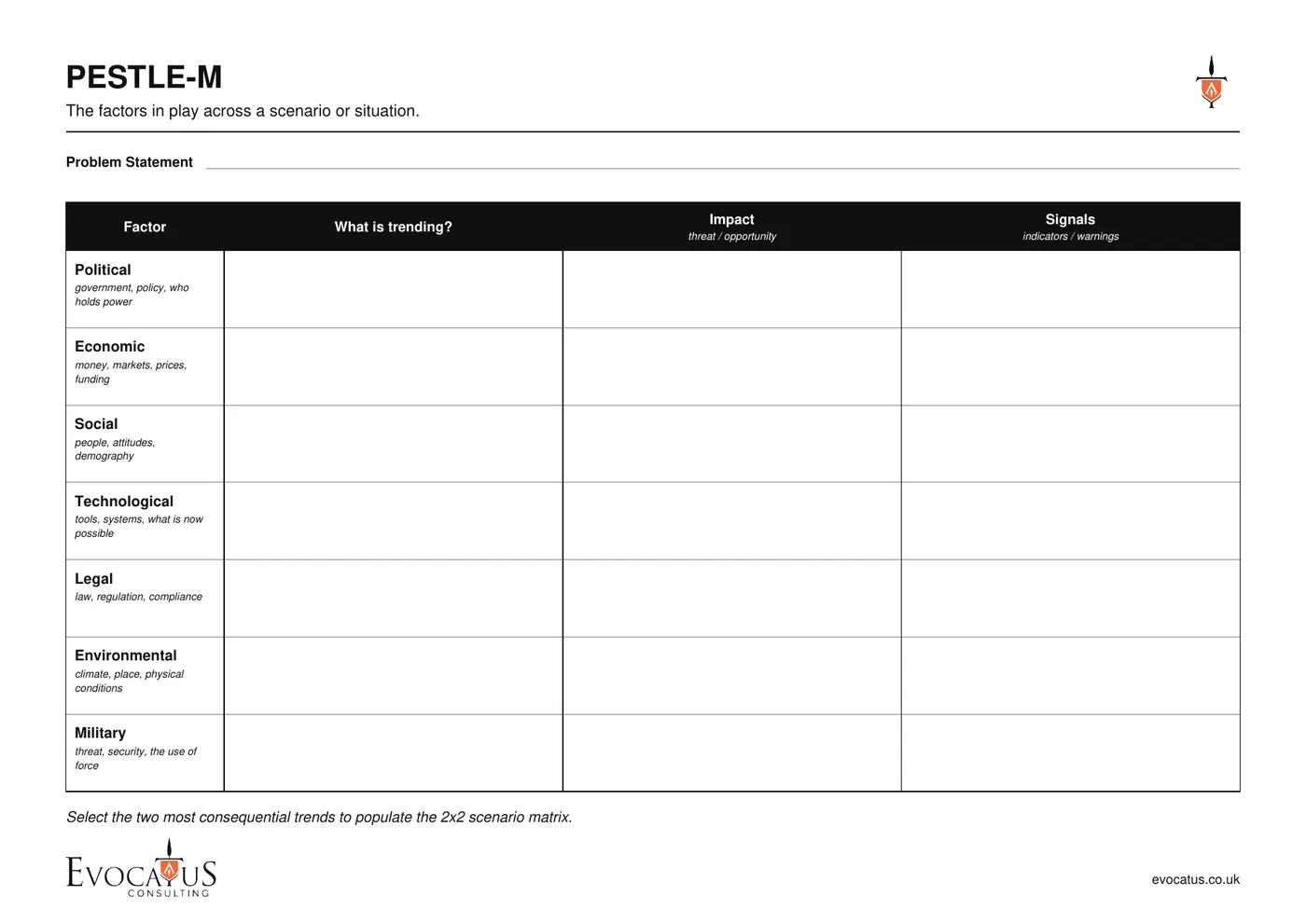
Two tools for looking ahead. PESTLE-M offers up the factors in play across any scenario and provides a framework through which to consider them and their impact on you. The 2x2 Scenario Matrix is a framework to explore how relevant factors interact to create a range of futures to use as scenarios.
Use PESTLE-M to understand what is changing around you, how much uncertainty it brings and what trends you might be able to recognise and plan a response to. Use the matrix when you want to explore a small set of possible futures. The sheets are designed to be used together: PESTLE-M ends by suggesting you choose the two most consequential trends, and those two become the axes of the matrix.
The Signals column on PESTLE-M is also the start of a routine for horizon scanning: once you know which signals matter, someone can be given the job of watching for them. For more on working with scenarios once you have them, see scenario analysis explained.
PESTLE-M
Why would I use PESTLE-M?
Use it when you are making a big decision or facing uncertainty and instability. PESTLE-M breaks factors down into seven areas in turn, from politics to security, and prompts you to think about expected trends in each, what they would mean for you, and what signals would confirm it was happening.
How to use it. Work down the factors impacting the Problem Statement, so that the trends you choose are relevant. Write each trend as a direction of travel, such as rising energy costs, and keep single events for the Signals column. Mark the impact as a threat, an opportunity or both. Then the signals: what you could actually observe, in a report, a price or a decision, that would tell you the trend is moving. Finish by choosing the two trends that would matter most, preferably ones whose direction you cannot call with confidence, and carry them to the 2x2 Scenario Matrix.
Why the M? We add Military to the usual six because security and the use of force now affect organisations that never thought of themselves as exposed to them, through supply chains, energy prices, cyber attack and insurance. If it has no bearing on your problem, leave the row blank.
PESTLE and its variants (PEST, STEEP, PESTEL) grew out of Francis Aguilar’s work on scanning the business environment in 1967.
Download PESTLE-M (A4 landscape PDF)
The sheet arrives by email. The button in that email confirms your address and opens the PDF. You will also receive our newsletter, once a month, from which you can unsubscribe at any time if you don't find it useful.
The 2x2 Scenario Matrix
Why would I use The 2x2 Scenario Matrix?
Use it to think about how future possibilities could interact together to create alternative scenarios to plan and rehearse against, as environments for stress-testing or for understanding potential risks and opportunities.
How to use it. Set a time horizon first; choose a horizon far enough away for both trends to have moved a long way, and near enough that the futures still bear on decisions you face now, unless you are using the matrix for a specific purpose. A budget might look a year ahead; a strategy, five years or more. Take your two factors and write one on each axis. Low means the trend has barely moved by your horizon; high means it has moved a long way. Work through the quadrants one at a time: give each world a short, memorable name, then describe it in a few lines, including what it would mean for your customers, your people and your competitors. Then use the results as your alternative scenarios.
The two-axis method comes from the scenario planning tradition that began at Shell in the 1970s.
Download The 2x2 Scenario Matrix (A4 landscape PDF)
The sheet arrives by email. The button in that email confirms your address and opens the PDF. You will also receive our newsletter, once a month, from which you can unsubscribe at any time if you don't find it useful.