
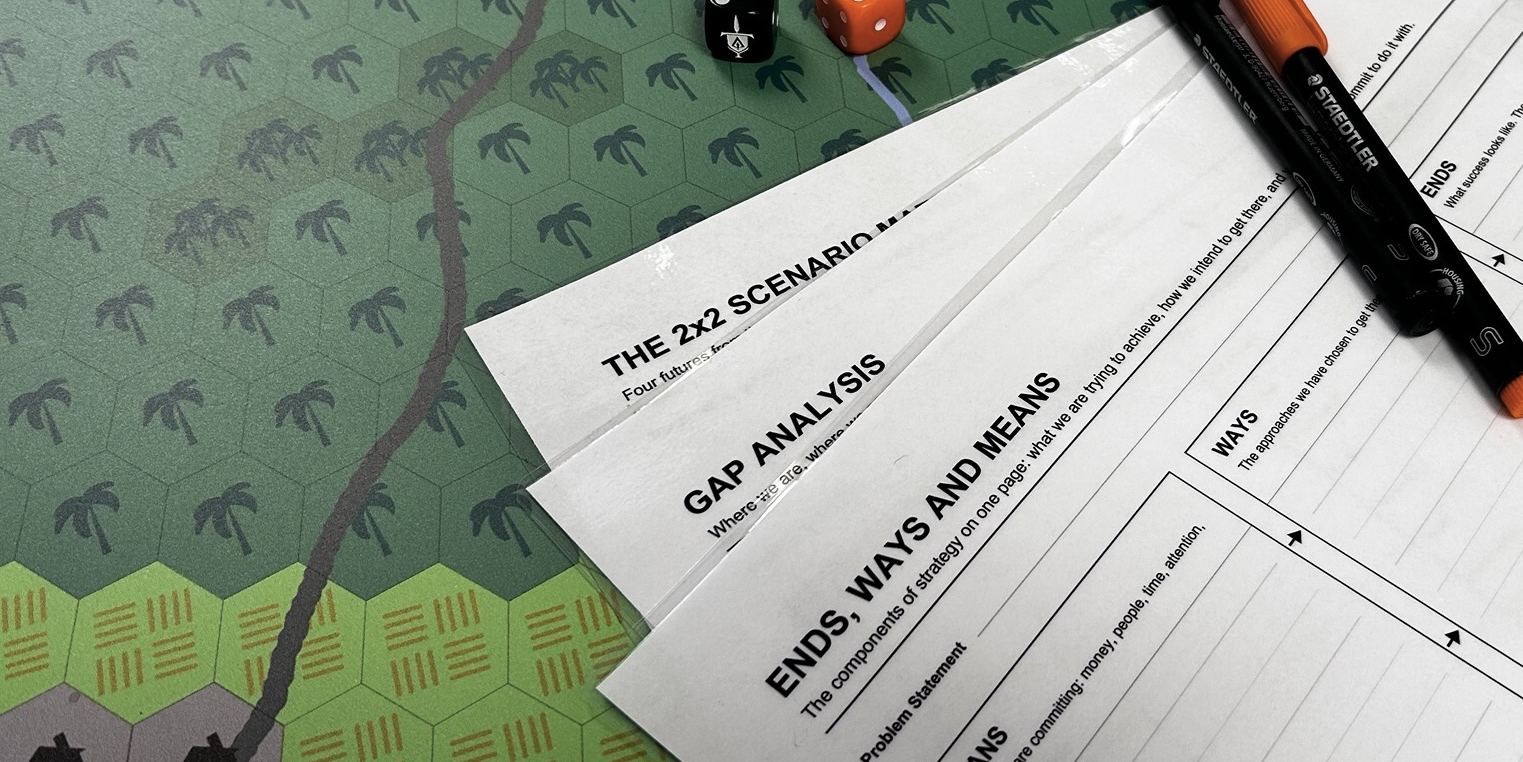
This is a repository for some of the practical tools we use to enable effective decision making, both during exercises and out in the real world. None of them is unique or original, but they provide accessible ways to organise your thinking and practically apply the theory underpinning our work. Some are adapted from military planning, some from the resilience community and a few from learning and development. We have only included tools we think are useful. The toolkit metaphor is entirely deliberate: select only the tools which are useful for the task in hand, rather than trying to apply all of them to every job.
What all the tools have in common is that each one can produce a hypothesis. A strategy on a page, a set of scenarios, a contingency plan for when the plan fails: all of them are structured guesswork until they are tested, either in an exercise or for real. The tools are also designed to be mutually supporting, with logic flowing between them where appropriate.
Decision making
For the choices you can see coming. The Seven Questions take a team from a messy problem to a structured plan in a fixed order. The decisions required to execute the plan and the data required to inform them become the rows of the Decision Support Matrix.
Stakeholders and strategy
Three tools for when a team needs to agree on what it is actually trying to do, and whose help it will need to do it. Ends, Ways and Means puts the strategy on one page: what success looks like, how you intend to get there, and what you are prepared to commit. The Gap Analysis Template then shows where you are against where you need to be and explores what closes the distance, line by line. The Stakeholder Mapping Template then sorts the people the plan depends on, against the strategy rather than in general. Use the first to draft and explore a strategy; use the second when you know where you need to get to, but don't yet understand what it will take.
Ends, Ways and MeansGap Analysis TemplateStakeholder Mapping Template
Foresight
Two tools for looking ahead. PESTLE-M lists the forces in play in any scenario and provides a framework through which to consider them. The 2x2 Scenario Matrix takes two uncertain factors as its axes and produces four futures to explore. Use PESTLE-M to understand the likely extent of uncertainty; use the matrix when you want to explore relevant potential futures before you commit to a plan.
Resilience and crisis
Two tools to aim off for when Plan A stops working. The PACE Plan gives options for each critical function. The Actions-On Card lists pre-identified events that could happen and a predetermined response. Use PACE when a function depends on one critical dependency; use the Actions-On Card when you want your crisis response to run like clockwork.
Red teaming
Two drills for testing a plan before the world does. Action, Reaction, Counteraction allows the plan to be played out against an attempt to make it fail, and records the potential impact. The Premortem assumes the plan has already failed and asks everyone involved to write down what they think broke it. Use the first when the plan will go up against an opponent, a competitor or another adversary; use the second when you need to guard against groupthink and confirmation bias.
Learning and debrief
Two templates for turning an exercise into a learning event. The Hot Wash is for a team leader to run in the ten minutes immediately after: what happened, what we noticed, what we would do differently. The After Action Review is the more deliberate version, usually run by a facilitator with clearer perspective; it turns observations and insights into a plan for improvement. Use the Hot Wash within the hour, while people still remember; use the AAR within a few days, before the next thing crowds it out.
Every sheet here is freely available to everyone signed up to the Evocatus newsletter. How your team behaves when the situation is real is the part we rehearse: Decision Support.