
Many organisations run workshops and exercises as a means to explain change or develop the team. Too often, though, they generate some real energy and engagement for a topic that really matters in the moment, only to have the audience forget everything but the fun of the event a week later.
Our solution to this is to run an After Action Review (AAR). More than just a conversation about how it all went, an AAR asks what was meant to happen, what actually happened, why the two differ, and how the team would do it better next time. Which decision, taken by whom, on what information, had the right impact? What surprised people by being more difficult or complicated than they had assumed? Where did information and understanding end up being unavailable to the people needing it? Whatever the experience the team has just gone through, they need to be able to reflect on what they all did if they are to learn and develop.
The theory underpinning our practice
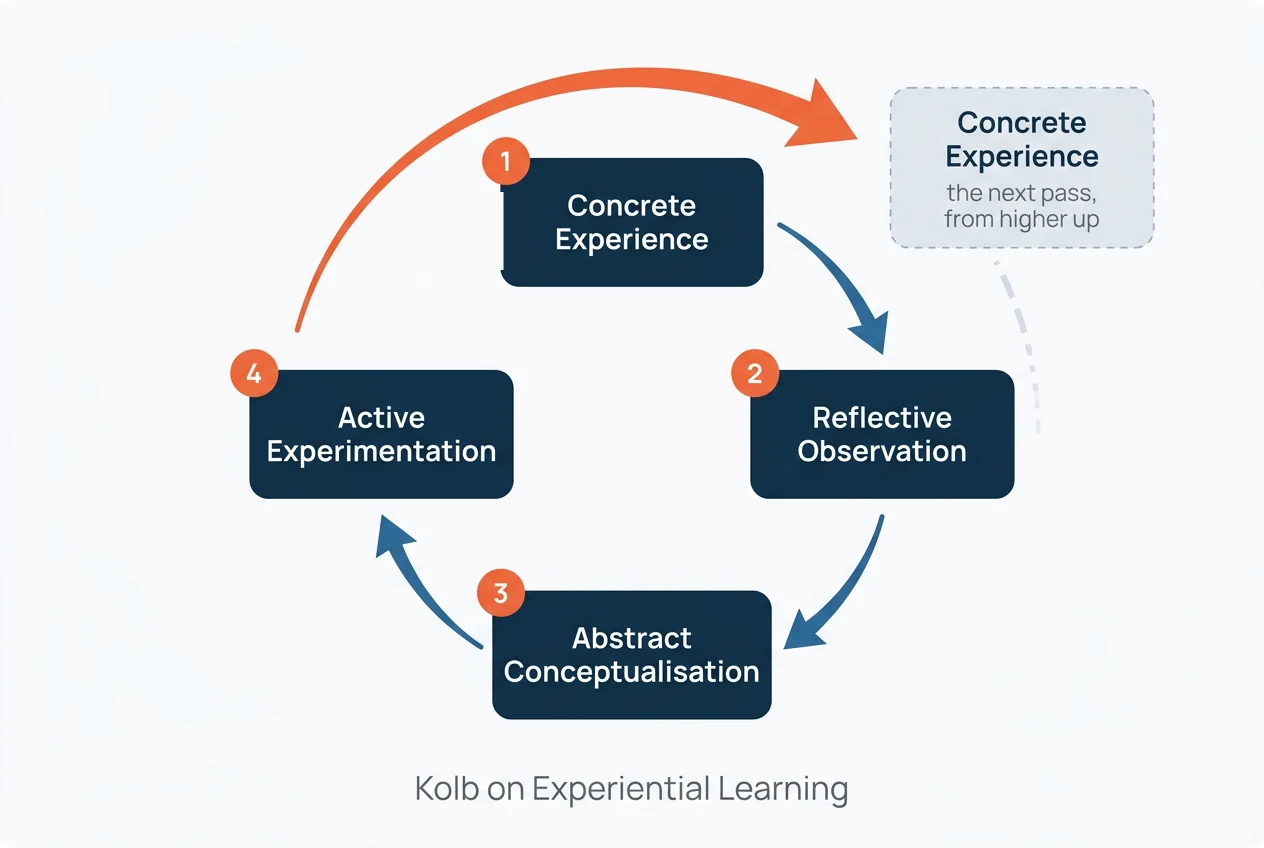
The clearest explanation of why this matters comes from David Kolb. His 1984 experiential learning cycle describes how experience turns into learning through four stages. It begins with concrete experience: the team does something real, or realistically simulated, and feels the consequences. Then comes reflective observation: stepping back to examine what actually happened, and why. Next up is abstract conceptualisation: drawing out the principle, learning the lesson that might allow improvement next time. Finally, active experimentation: testing that principle in action, which produces a fresh experience and sets the cycle running around again.
The experience itself is only one stage of four. An exercise, however vivid and well designed, delivers concrete experience and nothing more. The other three stages have to be made to happen, and in a busy organisation the first casualties are reflective observation and abstract conceptualisation. These are the engine for experiential learning, and the reason why an effective AAR is so important.
Three places where reflective observation happens
A proper debrief can sound like an event in its own right. A facilitator, an observer briefed to watch for the right things, a room booked and all the findings written up into a detailed report. The good news is that while a report might be useful, it is the reflection of the participants that really matters; getting them talking, describing and comparing their own experiences, is where the experience begins to transform into knowledge.
US Army doctrine settled part of this long ago by recognising two kinds of AAR. The formal version is planned and resourced: a dedicated observer, prepared materials, a scheduled slot, findings that go somewhere. The informal one is run on the spot by whoever was leading, takes ten minutes, and needs neither observer nor facilities. Both are effective. What separates them is scale, not seriousness, and the informal version is much the more common, given the lack of effort required.
There is also a third place that reflection happens. It is much less talked about, but completely natural and really important in corporate settings. When we run a game or a tabletop exercise, we make sure that we include time for everyone to step away for a break. Over coffee or corporate pastries, they naturally chat with the next person in the queue, trying out observations and half-formed insights. They test an idea on one colleague as they develop the confidence to share it with the whole group. Time spent in this kind of reflection feeds the main event at the end of the day, particularly when the idea is a vital, technical detail that is hard to just stand up and say to a large audience.
There are many arguments for running exercises in person, around a real tabletop, but one of the strongest is that it creates the space and engagement to help participants start their reflection early in the day. Run it online and nobody gets that.
Learning is a spiral, not a circle
Kolb described learning as a spiral, rather than a circle. Each pass through the four stages does not return the team to where it started, but sets them off again from slightly higher up.
This is why one good debrief produces a lesson, but a series enables genuine development, building habits, changing behaviours and delivering real impact. Part of our approach to organisational learning is the option to run either a series of iterative events, or to run exercises as a train-the-trainer experience, enabling businesses to develop their own capability.
This idea, certainly for defence, is much older than Kolb. In 1904 Ernest Swinton published The Defence of Duffer’s Drift, in which a young officer dreams of the same defensive position six times, getting his plan differently wrong each time, but improving continually until he finally succeeds at the last attempt. Six experiences, six reflections, six revised principles, each one tested on the following attempt. It was written as a tactical primer, is still in use, and it beautifully illustrates Kolb’s spiral eighty years before Kolb set it down.
The final question to ask before your next exercise
So next time you run an exercise where you are hoping to achieve change or learning, do think about what comes after the experience, and how to transform it into knowledge. Make time for those little breaks for reflection and confidence, make sure the debrief is planned against your objectives and led by an effective, inclusive facilitator, and think towards the next turn around the spiral, building on what you’re planning right now.
If you need a hand with any of the above, get in touch with us at Evocatus. It’s what we do!