
Stakeholder mapping describes the people involved and how much you think they matter. It won’t predict what they will do. A stakeholder map drawn without a strategy is a cast of players; a map drawn against clear ends, ways and means shows who can stop you, who you need, who could help if they chose, and who can only watch. Either way it is a set of educated guesses about other people, and the only way to weigh up the quality of those guesses is to game them out.
What is stakeholder mapping?
Stakeholder mapping is the practice of working out who can affect a plan or be affected by it, sorting them by how much power they hold and how much interest they have, and deciding how each one should be engaged. The output is usually a grid, a set of priorities and a communications plan.
The method is well established and worth doing. Most versions follow the same path: decide who counts as a stakeholder, group them, score each one for power and interest, plot the scores on a power interest grid, and assign a contact level to each box, from manage closely down to monitor. Some variants swap the second axis for urgency, legitimacy or how likely a stance is to change, and the fuller versions add an engagement assessment that records where each stakeholder stands now and where you need them to be, with the resulting gap a requirement for an engagement task.
All of it relies on unilateral, single-directional assumptions and thinking. Attributes are assigned to other people with different perspectives, converted into a schedule, and then reviewed every quarter. The stakeholder is never given a voice.
Why does a stakeholder map need a strategy behind it?
Power and interest are not absolute properties of a person, or an organisation. They are properties relative to the activity in question. If the strategy is not taken into account, the scores on the grid are just a series of opinions about importance.
A stakeholder map drawn up without a clear strategy is just a cast of players. With clear ends, ways and means, it shows who can stop you, who you need, who could help if they chose, and who can only really watch. Either way it is an untested hypothesis until those players have been given a perspective, a voice and the opportunity to make a decision.
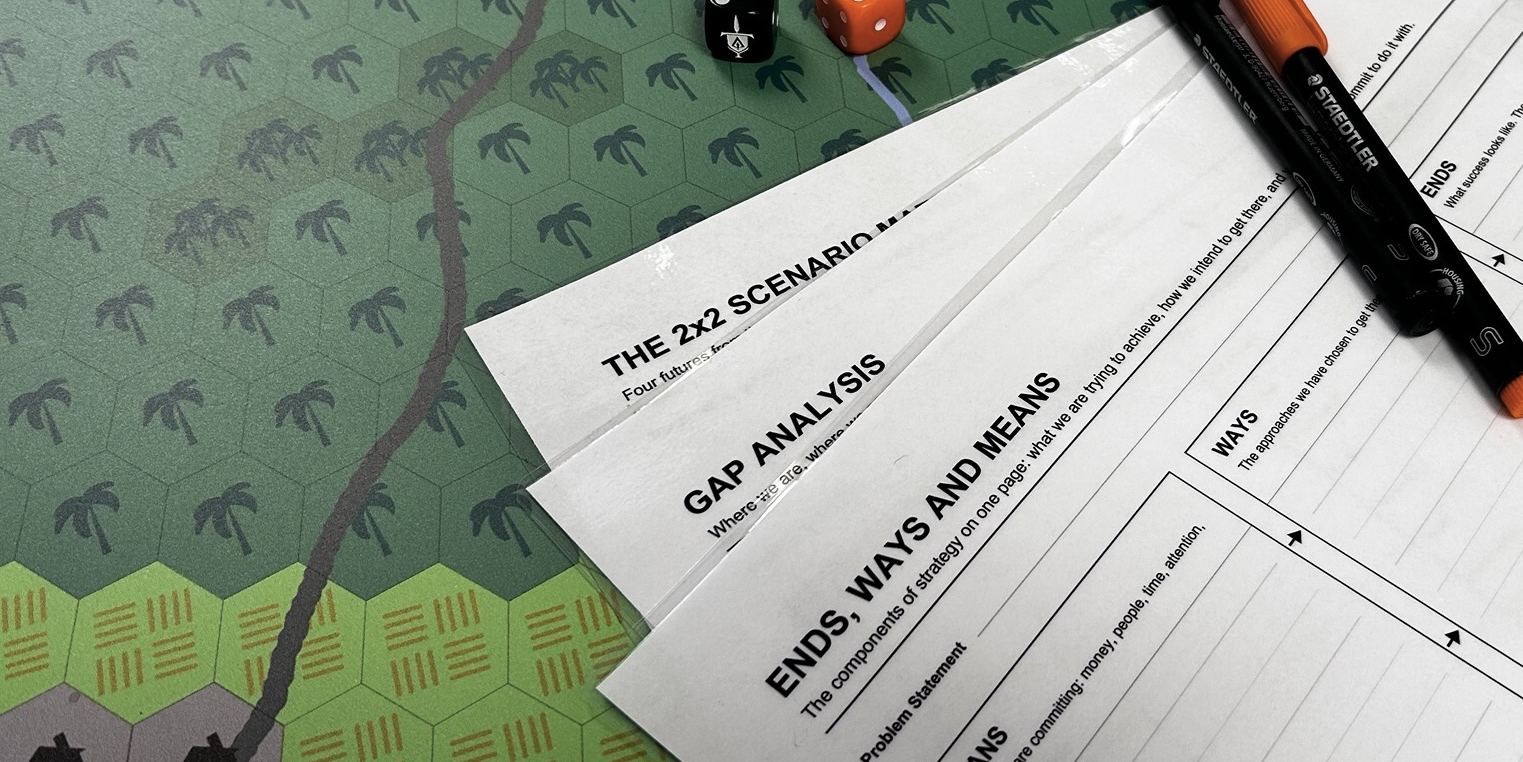
Strategy, in the sense we use it, is the relationship between ends, ways and means: what you are trying to achieve, how you intend to get there, and the resources you have to do it with. Stakeholders belong to the second of those. They are the people your plan depends on: some hold the means you are short of and could supply them, some can clear blockers you cannot overcome yourself, and some can impose them. Seen against the ends, most stakeholders look less like obstacles to be managed and more like potential partners whose interests you have not yet understood.
That is why a stakeholder map needs the strategy as context. Without it there is no basis for saying a regulator matters more than a trade body, or that a board member is high power and low interest; both are just names with scores beside them. So the first step is to write the ends, ways and means down on one page, then work out the gap between what the ways need and what you actually have. The map will follow that, and most of the names on it will have come out of the gaps: the people who hold what you are short of, and who might be persuaded to share it.
With the strategy clear, the cast sorts itself into four groups rather than four boxes. Some players can stop you, and you need to know how, why and when. Some players you need, because the ways depend on them. Some players could help if they chose: partners and allies whose support is optional, and who will give it only if they see a reason to. Some players, despite appearing influential, can only watch: they have no move that can impact the strategy, however senior they are. Those four groups are more useful than any grid because they are defined by the work you need to do, not just by a score, and each one gives the exercise a different question to ask: what would move the blocker, what the people you need will charge, what would make a potential ally bother, and whether the watcher really is as idle as the map says.
This is also an aspect of how problem scoping can be better nested within strategy. Who gets to define the problem is a question about stakeholders and their positioning; a map drawn before the strategy is clear may identify the loudest voice as the key stakeholder requiring management.
What can a stakeholder map not tell you?
A stakeholder map cannot foretell what anyone will do. Every box on the grid is a forecast presented as a category. “High power, low interest”, for example, is a prediction that a person will not engage. Stakeholder mapping alone tests none of these predictions before the engagement begins and the quarterly reviews only make an assessment in retrospect, when any potential surprises have already happened.
Organisations that have been caught out by a stakeholder reaction had a map, but nothing in the process had put assumptions about predicted behaviours under any pressure. The same is true of the engagement assessment, which identifies a gap between a stance now and the required stance, but it still makes assumptions based largely on educated guesswork. It is a hypothesis, not a plan.
How do you test a stakeholder map before it matters?
To test a stakeholder map, the stakeholders need the opportunity to answer back. In practice, that means an exercise in which the cast is given a stage: each key player is given their own perspective on the situation (based on their likely priorities, not on a stock role), a voice to say it with, and a decision to make that could impact the plan. Rather than scripting how stakeholders will react, they are included in the exercise as players with their own interests.
The design is simple to describe and hard to fake. A regulator played by someone who has been given the regulator’s incentives, the regulator’s constraints and a decision to take will behave in ways a simple grid cannot anticipate. The exercise provides far better insight into the range of possible behaviours and allows for some testing of what might work to close the engagement gap. It can also highlight those obstacles which no amount of stakeholder management can move. The stakeholder labelled “keep satisfied” turns out to have a veto; the player who was “manage closely” turns out to have no influence at all. The map gets developed through exploration by people who are behaving as the real ones might.
Two things to be clear about, because this is where the method is often oversold.
The exercise does not predict a specific future. It will not tell you what the real regulator will do in March, or which board member will change sides when the budget is reviewed. What it does is widen the range of behaviours the team has explored: they have now seen a plausible regulator do different things and have had to form responses to each. A map says the stakeholder is high power and low interest; an exercise explored what could make them more interested, and whether that is a help or a hindrance.
The exercise also does more than develop the map. When a team has heard a version of a stakeholder’s case out loud, they can mentally refer to that stakeholder’s model of the situation rather than just a label positioning them, and that provides a much better foundation for real-world engagement.
We have run this at scale for a global consumer goods group facing a top-down reorganisation, with regional teams playing the home side alongside competitors, commentators and critics. The teams came out understanding their critics’ arguments as well as their own, which in itself became a driver for change, turning a player audience from resistant to change into advocates. This sort of exercise is hugely effective not just for managing external stakeholders, but also for those inside the organisation, who are so often left off the stakeholder map.
Force field analysis, which lists the forces for and against a change and where each key player sits on a line from blocking it to making it happen, is the natural companion here. It gives the exercise a start point from which to explore and develop the analysis.
What should stakeholder engagement look like after the map?
Stakeholder engagement, done on the back of an explored, tested map, has a different shape. It is a plan against which decisions have been considered and rehearsed ahead of time. The plan includes predictions of who might be able to stop it and why they would; who it needs and how they might be kept on board. Every engagement conversation is based on having already heard a challenging version of the other side.
Every element of a plan benefits from a rehearsal before execution; stakeholder mapping is no different.
Frequently asked questions
What are the four steps of stakeholder mapping?
The usual sequence is identify, group, score and plot: list everyone who can affect or be affected by the plan, group them, score each for power and interest, and plot the scores to assign a contact level. Our view is that the four are bracketed by two more. Before them comes the strategic context the map is drawn against, the ends, ways and means. After them comes the test, when the people on the map are given a voice and a decision.
What are the four types of stakeholders?
The common grid produces four contact levels: manage closely, keep satisfied, keep informed and monitor. We find four groups defined by the strategy more useful: who can stop you, who you need, who could help if they chose, and who can only watch. The first three are the ones worth giving a voice to; the exercise finds out whether the fourth is really as idle as the map says.
What is the difference between stakeholder mapping and stakeholder analysis?
Mapping places stakeholders by attributes such as power and interest; analysis goes further into each one’s position, their interests and what they would accept. Both are hypotheses until tested.
What is the best tool for stakeholder mapping?
Any grid will hold the names. The tool that allows you to explore the map is an exercise in which the stakeholders are roleplayed and the team has the opportunity to rehearse their responses. The tools we start with are Ends, Ways and Means on one page, a Gap Analysis Template and a Stakeholder Mapping Template; all three are available in our toolkit.
Does a stakeholder exercise predict exactly what people will do?
No. It explores the range of what plausible players could do and lets the team rehearse responses across that range. A team that has seen a realistic range is better prepared than one that has bet on a single forecast.