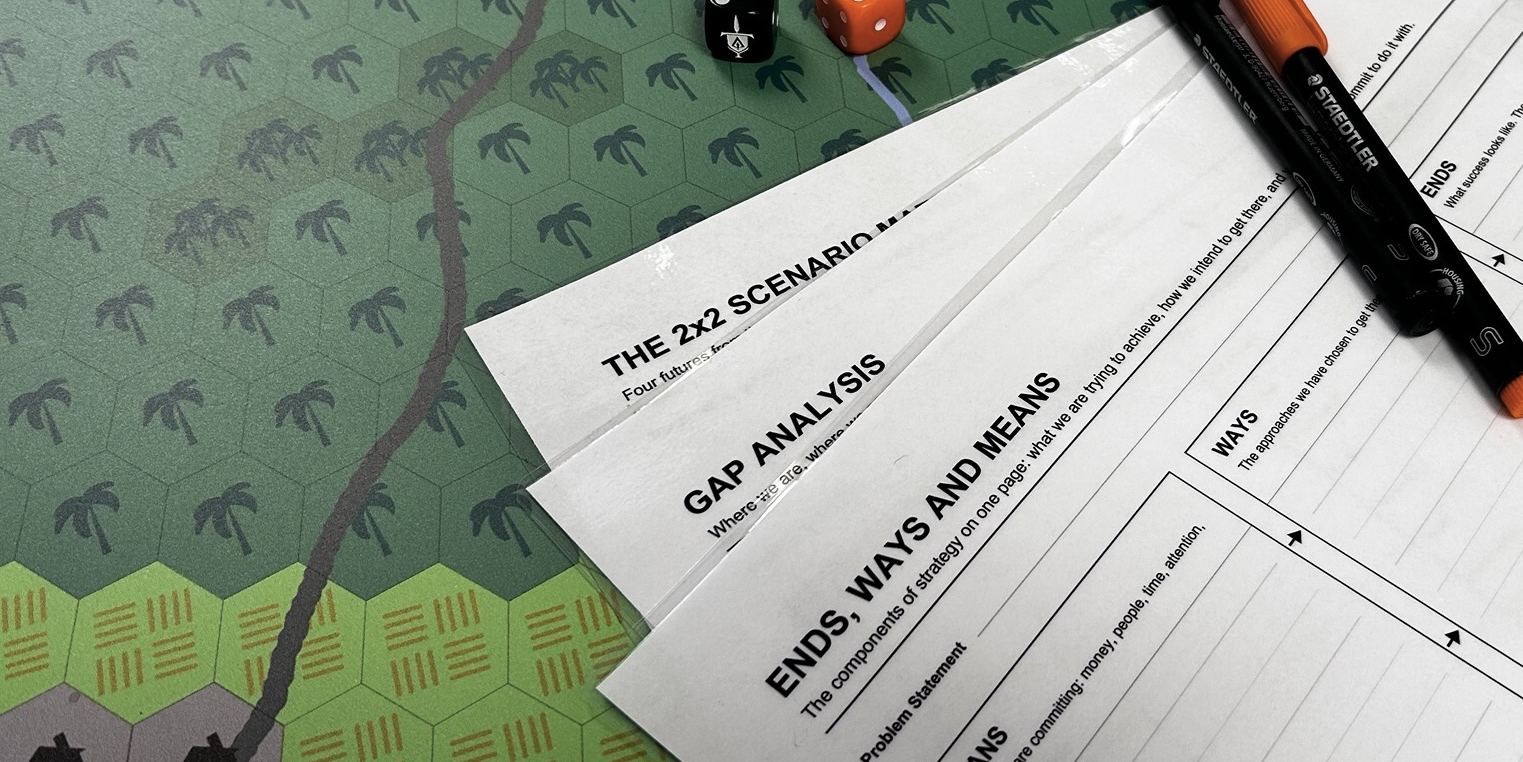
Three tools for when a team needs clarity on what it is actually trying to do, and whose help it will need to do it. Ends, Ways and Means puts the components of strategy on one page: what success looks like, how you intend to get there, and what you need to commit. The Gap Analysis Template then lets you explore where you are against where you need to be, and what it will take to close the distance. The Stakeholder Mapping Template then sorts the people the plan depends on, against the strategy rather than in general.
Use Ends, Ways and Means to draft and explore a strategy, using the framework to focus your thinking. Use the Gap Analysis Template when you know where you need to get to but do not yet understand what it will take. The two are designed to be used together: the ends from the first sheet become the desired state on the second, and exploring the gap should signpost the ways and means.
Both sheets feed the third, because the strategy is what tells you which stakeholders matter most. Why we draw the map that way is in our article on stakeholder mapping.
Ends, Ways and Means
Why would I use Ends, Ways and Means?
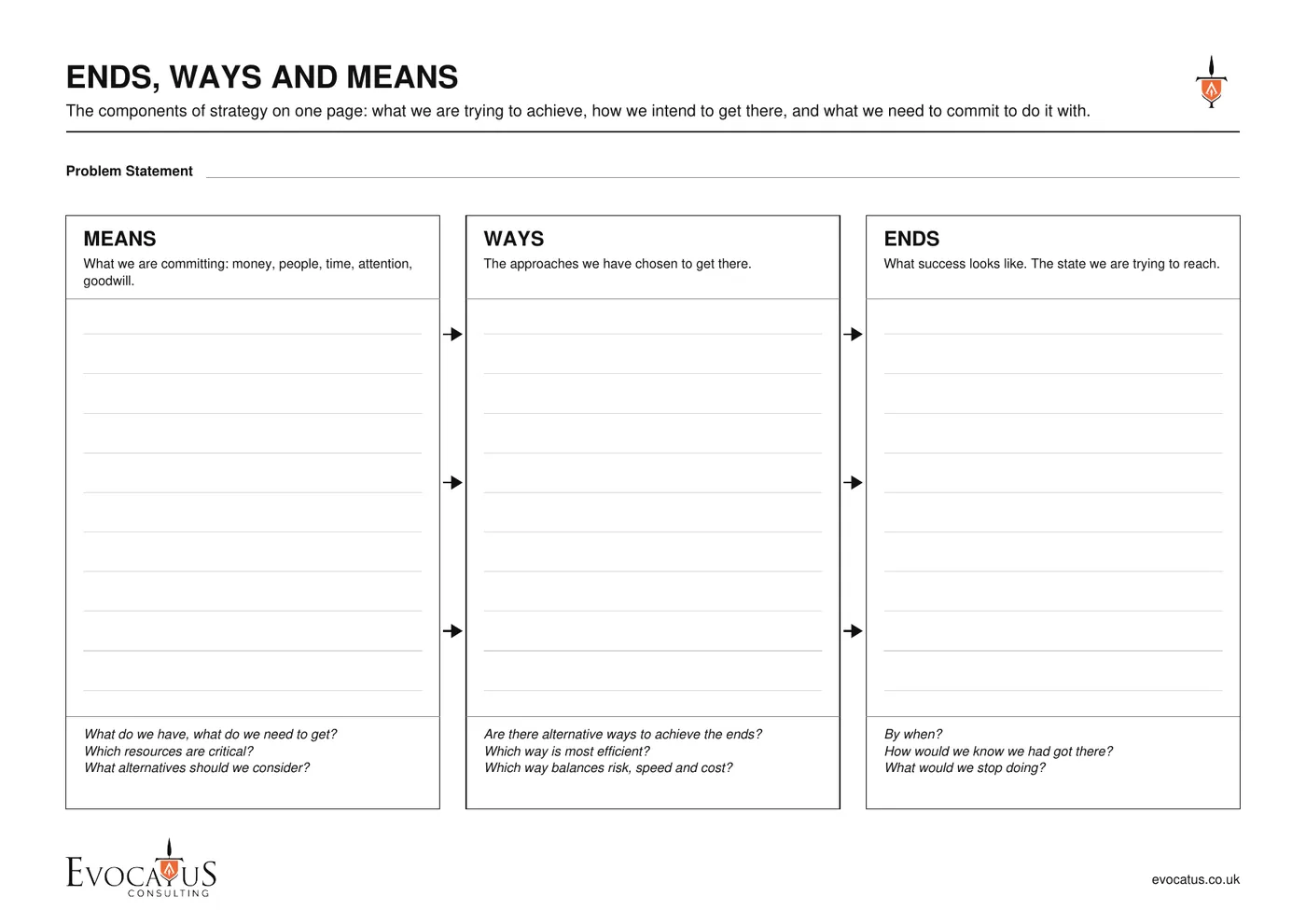
Use it when a team talks about being strategic but cannot say what its strategy is. The sheet asks for three answers on one page: what success looks like, how you intend to get there, and what you will commit to it. If the three do not add up, you have found the problem while it is still cheap to fix.
How to use it. Articulate the Problem Statement in one sentence before anyone starts on the columns to provide the underpinning context. Start by identifying what ends need to be achieved and then the ways you might take to get there; the Gap Analysis Template can help work up this part of the strategy. The means are then the costing element.
Ends, ways and means is the definition of strategy in military doctrine around the world.
Download Ends, Ways and Means (A4 landscape PDF)
The sheet arrives by email. The button in that email confirms your address and opens the PDF. You will also receive our newsletter, once a month, from which you can unsubscribe at any time if you don't find it useful.
Gap Analysis Template
Why would I use the Gap Analysis Template?
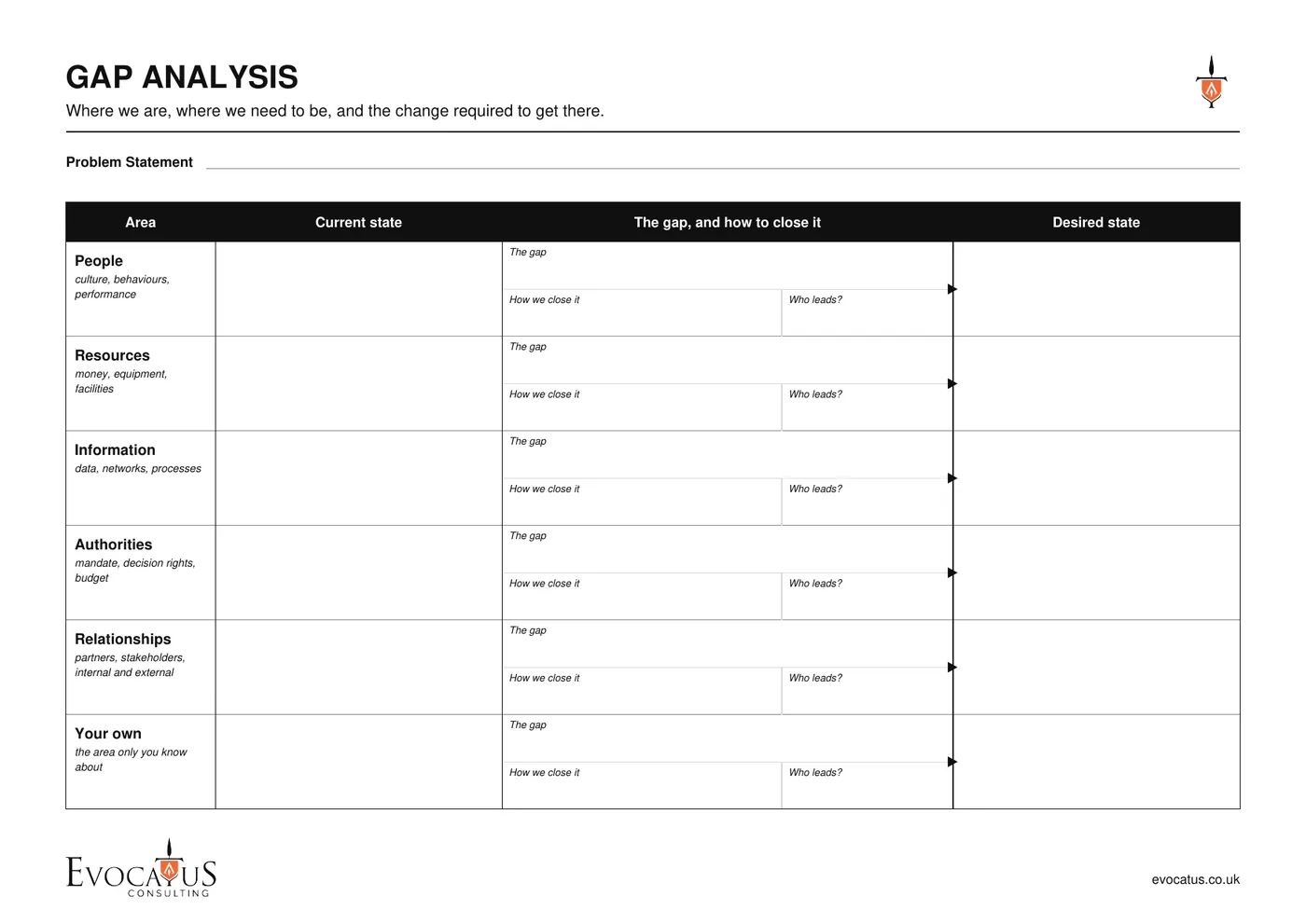
Use it when you know where you need to be and need to understand everything that must change before you get there. The template sets the current state against the desired state, and prompts thinking about the gap between them. The output will be a list of gaps, each with an action required and an owner responsible.
How to use it. Carry the Problem Statement and the ends across from Ends, Ways and Means, putting your strategic ends in the Desired state column first. Then fill in the current state, before describing all the aspects of the gap as clearly as possible. The actions that would contribute to closing the gap may signpost your strategic ways. Finally, naming an owner for each action gets a head start on building a plan.
Gap analysis comes in many shapes. Ours is built to nest within broader strategic problem framing, as part of the complete toolkit.
Download the Gap Analysis Template (A4 landscape PDF)
The sheet arrives by email. The button in that email confirms your address and opens the PDF. You will also receive our newsletter, once a month, from which you can unsubscribe at any time if you don't find it useful.
Stakeholder Mapping Template
Why would I use the Stakeholder Mapping Template?
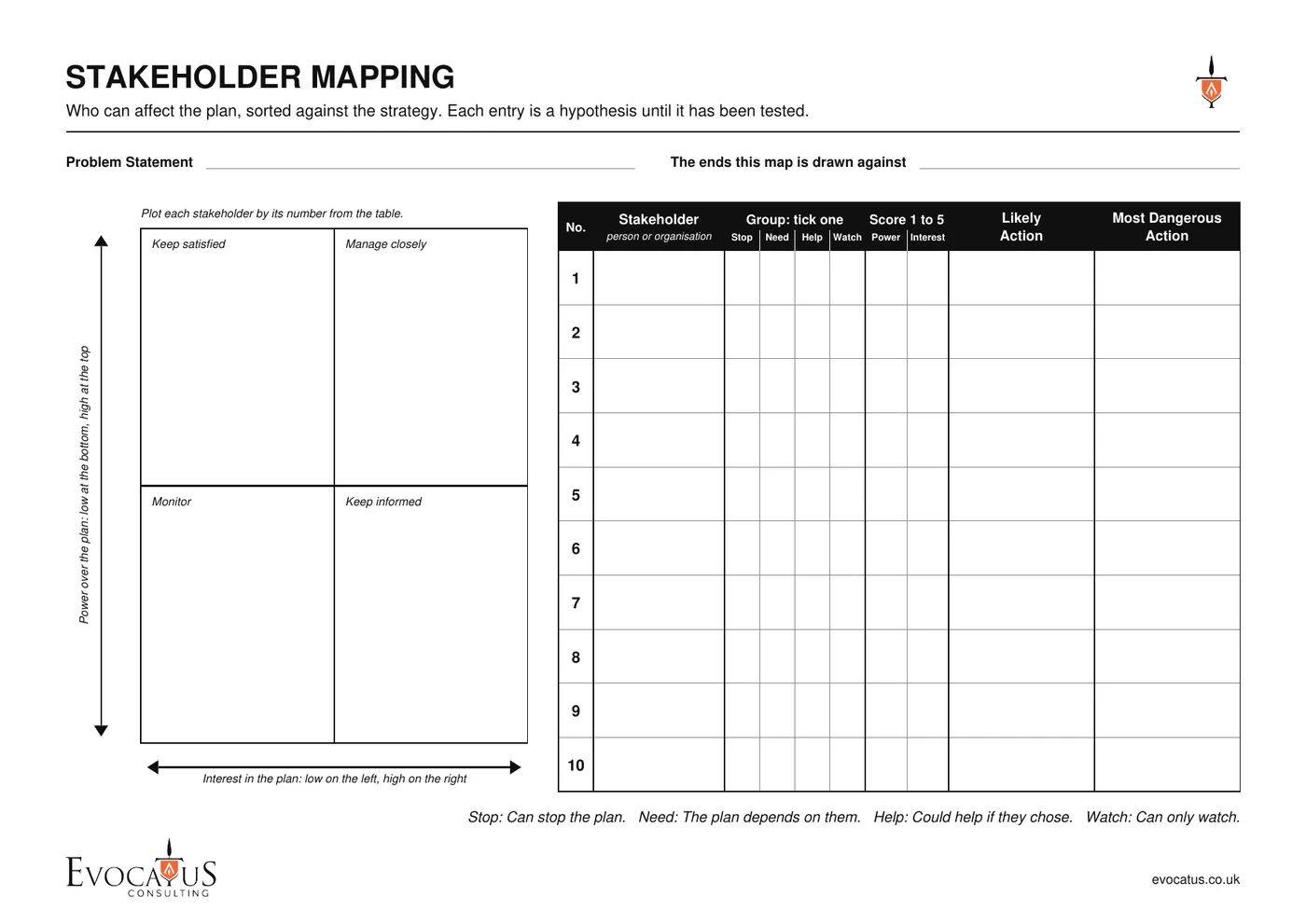
Use it once the strategy is on paper and you need to know whose behaviour it depends on. The template plots each stakeholder on a power interest grid, sorts them by what they can do to the plan, and records what you expect each one to do. Those expectations are what you test before the engagement begins.
How to use it. Start from Ends, Ways and Means. Write the strategic ends at the top, and use the ways and means to inform your first names for the grid. Score power and interest against this specific strategy; a board member can be high power on one decision and irrelevant to the next. The suggested groups describe the potential impact. Use the row numbers to plot each stakeholder on the grid. Then fill the last two columns. The most likely action is your forecast of what they will do by default; the most dangerous action is the greatest risk they pose to your plan if unmanaged. The final column is the risk worth putting into an exercise, to explore in detail from an external perspective, with a voice and decisions of its own.
The power interest grid is usually credited to Aubrey Mendelow and is used widely in government and project management. Ours adds the four groups, sorted against the strategy, and the two columns that make each entry something you can explore.
Download the Stakeholder Mapping Template (A4 landscape PDF)
The sheet arrives by email. The button in that email confirms your address and opens the PDF. You will also receive our newsletter, once a month, from which you can unsubscribe at any time if you don't find it useful.