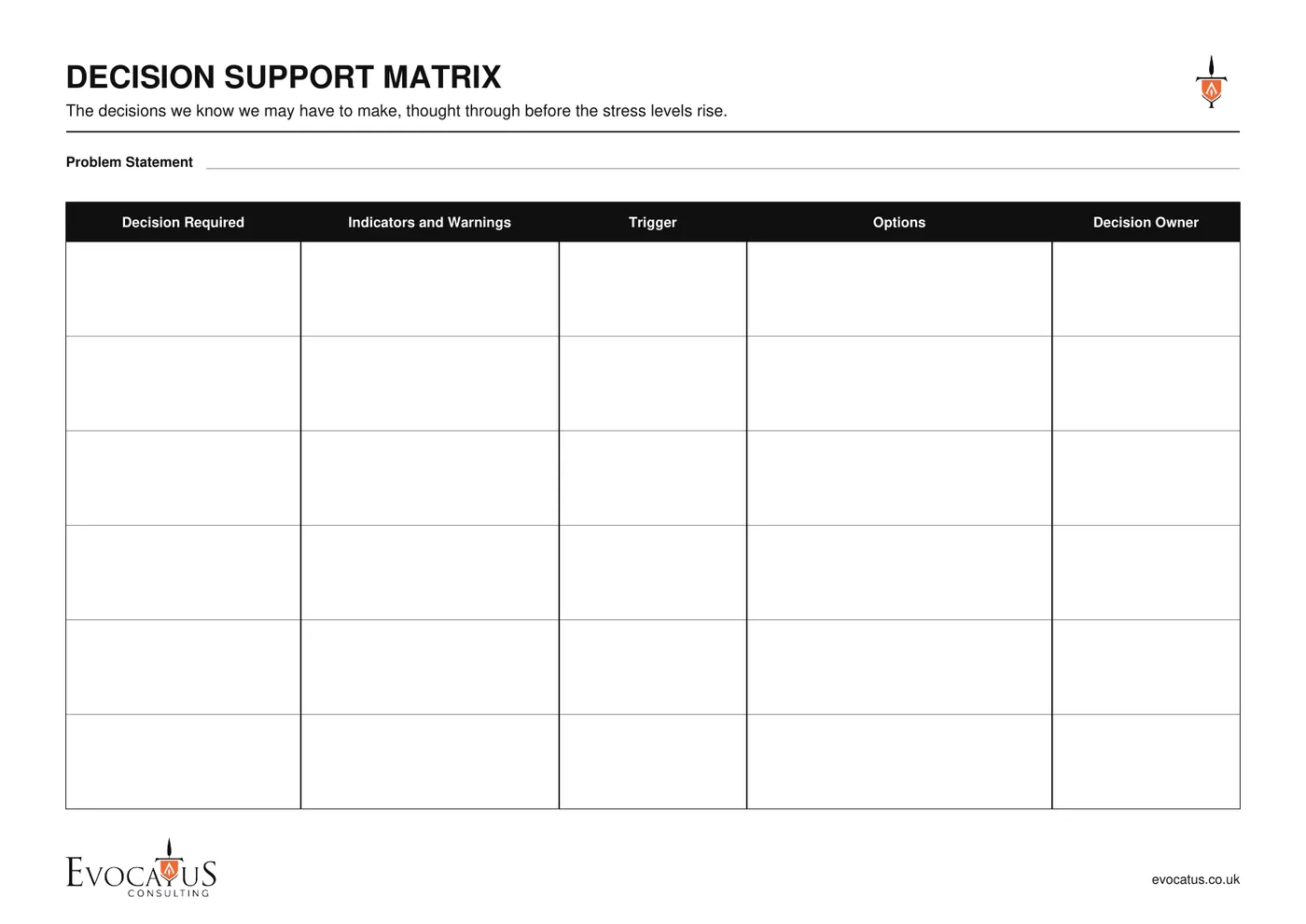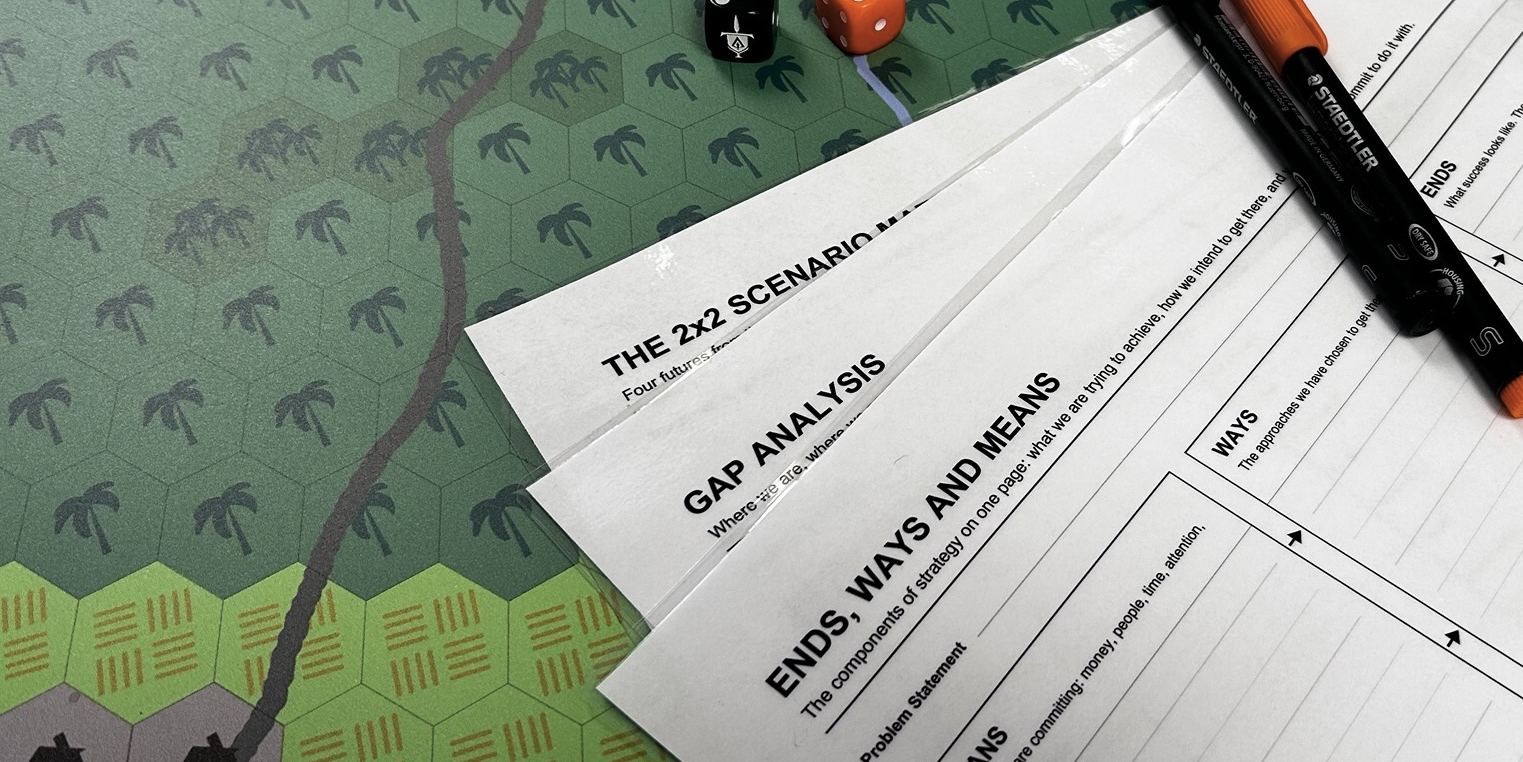
Tools for making more deliberate choices, even when time is short. The Seven Questions take a team from a messy problem to a structured plan in a fixed order. The Decision Support Matrix is a tool for capturing decisions made in a rehearsal exercise or a wargame, so that responses can be decided in a low-stress setting ahead of the anticipated crisis.
How a team prepares to take those decisions once the clock is running is the subject of our guide to decision making training and our article on decision making under uncertainty.
The Seven Questions
Why would I use The Seven Questions?
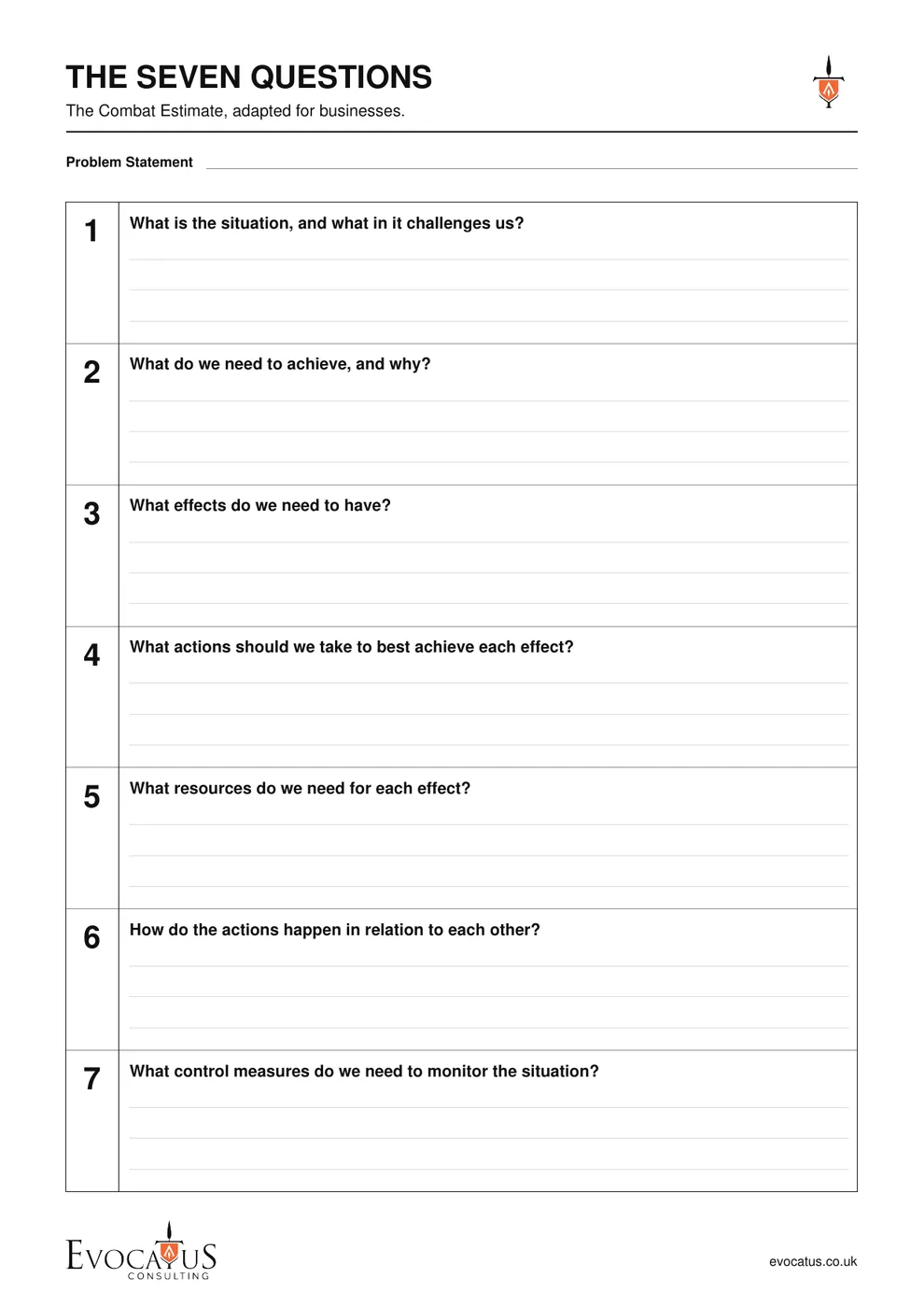
Use them when you have been given a complex task and want to understand it in detail before making a plan. The Seven Questions set an order: the situation, the aim, the effects, the actions, the resources, the sequence and the controls. Answering them in turn leads you to a plan.
What each question asks.
- What is the situation, and what in it challenges us? The facts first: what is happening, who else is involved, what they want, and where we stand. Then what in that picture threatens or complicates what we are trying to do. Write down what you do not know as well as what you do; the unknowns become assumptions to check.
- What do we need to achieve, and why? The task in our own words, and the purpose behind it. Include the tasks nobody stated but which still have to be done, and any constraints.
- What effects do we need to have? The changes in the situation that would mean the task is achieved: a product released, a process implemented, a competitor’s new offering matched. Describe outcomes here and leave the actions for question four.
- What actions should we take to best achieve each effect? For each effect, the activities required to deliver it. Where there is more than one way, we choose the most appropriate, which could be the fastest, the cheapest or something else.
- What resources do we need for each effect? People, money, time, equipment and information to deliver the actions. Set a budget for the plan, and if it outstrips the available resource, circle back to question four to look for a more efficient solution.
- How do the actions happen in relation to each other? The sequence: what has to happen first, what has to happen at the same time, and what depends on what. A simple timeline or a list of phases is enough. Points where one action sets the conditions for another are usually decision points.
- What control measures do we need to monitor the situation? How we will know the plan is working: the metrics, reports, checkpoints and indicators we will watch, and who is responsible for watching them.
How to use it. Work through the questions in order and do not jump ahead. When all seven are answered, the marked points become the rows of the Decision Support Matrix. For a large problem, each question may need a session of its own.
The combat estimate is the tactical planning method taught by the British Army. Having used it and taught it for decades, we have reframed it for organisations not facing an enemy objective, but kept the order and the logic unchanged.
Download The Seven Questions (A4 portrait PDF)
The sheet arrives by email. The button in that email confirms your address and opens the PDF. You will also receive our newsletter, once a month, from which you can unsubscribe at any time if you don't find it useful.
The Decision Support Matrix
Why would I use The Decision Support Matrix?
Use it when you have run a wargame or a rehearsal exercise and you want to turn experience in the simulation into a handrail for decisions in the real world. The matrix gives each decision a row: what you would see as it approaches, the trigger that says it must be taken now, the options to choose between, and the one person who owns the call. When the moment arrives, the thinking has already been done.
How to use it. Use the matrix to record key decisions taken during a rehearsal activity. Afterwards, review the decisions and work up a mini-plan for each, with as much of the indicated detail as possible. Triggers need to be carefully thought through, to make them both visible and timely.
The Decision Support Matrix comes from military planning, where its focus is traditionally on picking alternative actions based on intelligence and conditions.
Download The Decision Support Matrix (A4 landscape PDF)
The sheet arrives by email. The button in that email confirms your address and opens the PDF. You will also receive our newsletter, once a month, from which you can unsubscribe at any time if you don't find it useful.