
Decision making training is practice at choosing under pressure of time, with less information than you would like and real risk whichever way you turn. Good training balances pace and accuracy, because a perfect decision taken late is as damaging as a quick wrong one. It builds the whole of decision making competence (knowledge, skills, experience and behaviours) through repeated exercises set inside the team’s own strategy, and it keeps that competence current.
What is decision making training?
Decision making training is not about preparing for the easy choices, but about being ready for the really hard ones, under pressure of time, without as much information as we would like and with a genuine element of risk whichever way we turn. It’s about recognising when delay will just turn a decision into a dilemma, but also about having the confidence and courage to pause and think before reacting out of panic. As experienced leaders in the most challenging circumstances, we believe that training for these sorts of decisions is only possible through exercises based in relevant and challenging scenarios.
Why do good leaders make bad decisions?
Good decisions are about balance. Perfect decisions too late and rushed decisions just being wrong can both cause disaster. Decisions made by senior British officers at Balaklava (in 1854) and Suvla Bay (in 1915) are sobering case studies of the missed opportunities and reckless waste that leaders can inflict on those for whom they are responsible.
At Balaklava, the 7th Earl Cardigan failed to consider the intention behind his orders before leading the Light Brigade’s fateful, famous charge. At Suvla Bay, Lt Gen Stopford failed to exploit the opportunity of a relatively unopposed landing for days, meaning that the enemy had reinforced ahead of costly and ultimately futile attacks onto the high ground overlooking the beach.
Both officers were out of their depth, promoted to high rank and selected for their command purely through purchase, up to a point, and then length of service, rather than experience, skill or leadership quality. Neither had a background in effective decision making under pressure, and both had a career more focussed on drills, inspections and turnout on parade than on combat operations.
What is decision making competence made of?
Competence in decision making is the full set of knowledge, skills, experience and behaviours, known as KSEB. Knowledge underpins the other three and is the easiest to teach, at least as theory. Skills, experience and behaviours are more difficult to develop; all three take application in practice to build and to sustain.
Closing the gap so clearly demonstrated by Cardigan and Stopford is about much more than understanding the theory. Models, frameworks and processes are useful, and a good foundation for decision making training, but they are just the start. Only experience, real or simulated, provides the means for teams and individuals to build the skills and behaviours required to make the right calls at the right time. And this experience needs to involve making a few of the wrong decisions, or the right ones at the wrong time; learning from mistakes in training is always time better spent than perfectly executed drills.
Decision making training which concentrates only on teaching theory is academic. To give it vocational value, incrementally challenging practice is required.
| What it is | How it is gained | How it fades | What exercise adds | |
|---|---|---|---|---|
| Knowledge | Models, frameworks, procedures, and what the team knows about its own organisation | Courses, reading, briefings | Slowly, and it can be refreshed from a notebook | A test of whether it is known well enough to use under pressure |
| Skills | Using that knowledge: effective communication, framing options, weighing risk, stating intent, delegating | Practice and reflection | Quickly, without regular use | Repetition within a safe environment |
| Experience | The store of previous situations a decision maker can use to inform their performance | Exposure, real or simulated | Fades as the team and situation change | New situations added faster, more cheaply and with less risk than real-world events |
| Behaviours | How the team acts as individuals and together under pressure: challenging, conferring, committing | Role-modelling, reflection and practice until it becomes culture | Erodes when not maintained, reinforced, or when people change | Provokes behaviour under stress, allowing the debrief to reinforce the good |
Why does experience matter so much?
Seasoned decision makers mostly recognise patterns and compare each challenge to a mental reference library of situations they have faced before, applying the most appropriate past experience to the current problem. While tools and frameworks are useful for checking decisions and for shared decision making, it is experience, real or simulated, that feeds that mental reference library.
Gary Klein spent decades studying firefighters, intensive care teams and military officers making decisions under pressure. He found that experienced people rarely lay out options and score them. They recognise the situation, see a workable course of action, check it quickly in their heads and act. He called this recognition-primed decision making, and his work has shaped a great deal of human factors training since. The pattern library it relies on is built by exposure; reading about situations adds very little to it.
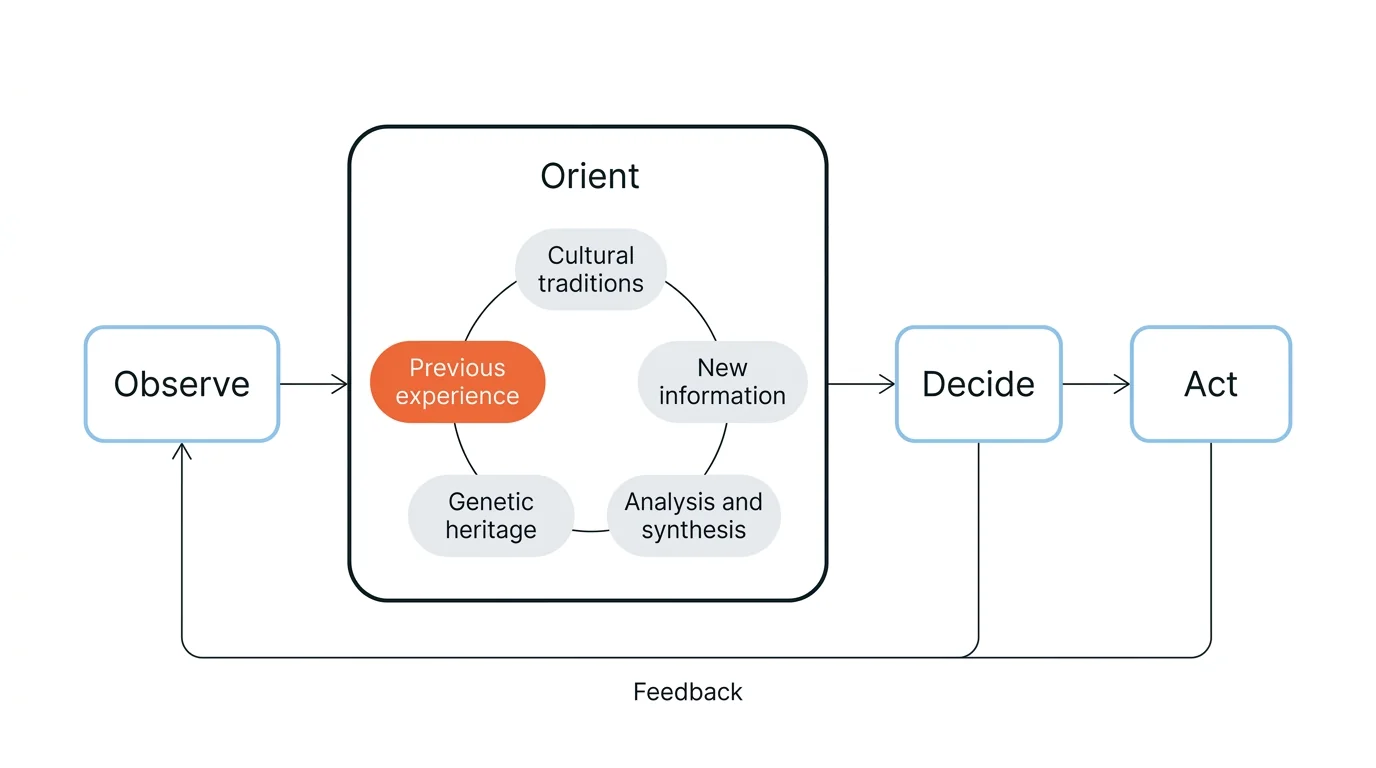
John Boyd’s decision cycle (observe, orient, decide, act) is usually drawn as four boxes and read as a race. Boyd treated orientation as the engine of the whole loop, the point where previous experience, culture, analysis and new information combine into the picture the decision maker actually sees. A fast cycle with poor orientation produces fast but wrong decisions, as with Cardigan charging the guns. Waiting to observe more when the picture is already good enough to act is Stopford on the beach.
Daniel Kahneman and Klein came at judgement from opposite directions, but reached agreement in 2009. Intuition can be trusted where the situation offers reliable cues and the decision maker has had enough practice, with clear and timely feedback, to learn and recognise them. It is a poor guide where the situation is new to the person deciding, where the cues mislead, or where feedback arrives too late or too muddled to learn from. Exercises provide a unique way to create experiences and then pull learning out of the complexity of what happened, enabling participants to recognise when to act decisively and when to slow down and think.
Why does decision making competence fade?
While knowledge can always be refreshed from a notebook, skills and experience are perishable and strong behaviours need to be role-modelled and shared to keep them embedded in team cultures. The Army trains teams through an annual cadence, with individuals qualified on courses brought together into teams who then need to learn how to work together, apply their specialist knowledge and support the commander’s decision making during a series of increasingly complex exercises.
Qualification is relatively straightforward to achieve; maintaining currency and competence takes practice.
What does good decision making training look like?
Really good decision making training requires six design elements.
It is set inside the team’s own strategy. The scenario is built from the organisation’s real ends, ways and means, and from the decisions its managers are actually paid to take. That is why the discovery work before an exercise is part of its design, and why an off-the-shelf package struggles to do the job, however good the facilitator.
It has friction, an opponent and a clock. Information arrives incomplete and out of order, someone is actively looking for ways to pressurise the plan, and time is short. Take away any one of the three and the exercise is likely to be too comfortable to have a real impact.
It scores pace and accuracy together. The debrief records what was decided, when, on what information, and what an extra ten minutes would have changed. It also records the shape of each decision: the caveats it carried, what was delegated and to whom, and the triggers set for revisiting it.
It repeats, and each run is a little harder. A single scenario gives a team an experience. Genuine learning and development comes from an iterative series, for the same reason the Army builds its year from individual courses to increasingly complex team exercises. The first run is hard work, but by the third or fourth the approach has become a habit. This is scenario based learning in its proper sense: repeated practice with feedback.
It exercises the whole team. Decisions in organisations are made by people who have to collaborate, confer, communicate and compromise before anything is final. An exercise brings all four into play, unlike a course or a briefing, which leaves no room to practise disagreement and challenge.
It leaves a written record. Insights, observations and lessons collected during the exercise are the fuel for improvement of both the plan and the team’s delivery of it. Sustaining what went well is important, but developing what didn’t is crucial.
What do different exercise formats offer?
| Format | Suits | What it exercises | Choose it when |
|---|---|---|---|
| Decision making games | Teams building the habit for the first time; leadership teams that want pace under a clock | Framing and pace, and the team behaviours around the decision | You are starting out, or keeping a team sharp between larger exercises |
| Tabletop exercise | Teams with a plan that needs walking through | Knowledge of the plan, roles, handovers and gaps | A plan exists and needs rehearsing with the people who will run it |
| Scenario exercise with a red team | Confident teams that believe they have an answer | Decisions against an adaptive opponent, and the assumptions beneath the plan | The team needs to find out whether its answer holds |
If your leadership team has a decision making framework and little recent practice, the first step is simply practice. Start with a decision making game set inside your own strategy, score pace and accuracy in the debrief, and put a second run into the diary before the first one finishes. This is where our decision support and problem solving services come in, and the design always begins with understanding the real decisions a client wants to prepare for.
Frequently asked questions
What is decision making training?
Practice at choosing under time pressure with incomplete information, using scenarios drawn from the organisation’s own strategy. It develops the balance between pace and accuracy, and the skills, experience and behaviours that sit on top of any decision making framework.
Who is decision making training for?
Managers and leadership teams who take decisions under pressure: operational managers, crisis and incident teams, and boards. Decision making for managers and decision making in leadership draw on the same competence; what changes is the scale of the consequences and the size of the team deciding.
Is a decision making framework enough?
A framework is knowledge, and knowledge underpins competence without amounting to it. Skills, experience and behaviours are built by using the framework under pressure, and they fade without practice.
How often should a leadership team exercise its decision making?
Often enough that the shared picture does not thin back into individual assumptions: for most organisations more than once a year, and after any significant change of people or plan.
What is the difference between a decision and a dilemma?
A decision is a choice between options that have real merit; a dilemma is a choice between options that all carry a cost. A decision left too late tends to become a dilemma.