Two tools for testing a plan before the world does. Action, Reaction, Counteraction allows the plan to be played out against an attempt to make it fail, and records the potential impact. The Premortem assumes the plan has already failed and asks everyone involved to imagine what they think broke it. Use the first when you are confident that your plan is sound and needs testing; use the second when you need to guard against optimism, linear thinking and confirmation bias.
Both tools are best used once a plan exists but before it is committed, while there is still time to refine it. The Seven Questions and The Decision Support Matrix may have provided that plan. The outputs of these tools fold back in as weaknesses you can fix, and risks you hadn’t predicted.
These are drills a team can run for itself. Where the stakes justify a dedicated opposing team, that is a service we provide: red teaming.
Action, Reaction, Counteraction
Why would I use Action, Reaction, Counteraction?
Use it when your plan is developed enough to be tested under pressure. The drill plays the plan forward one turn at a time, with someone playing red, looking for ways the plan could be frustrated.
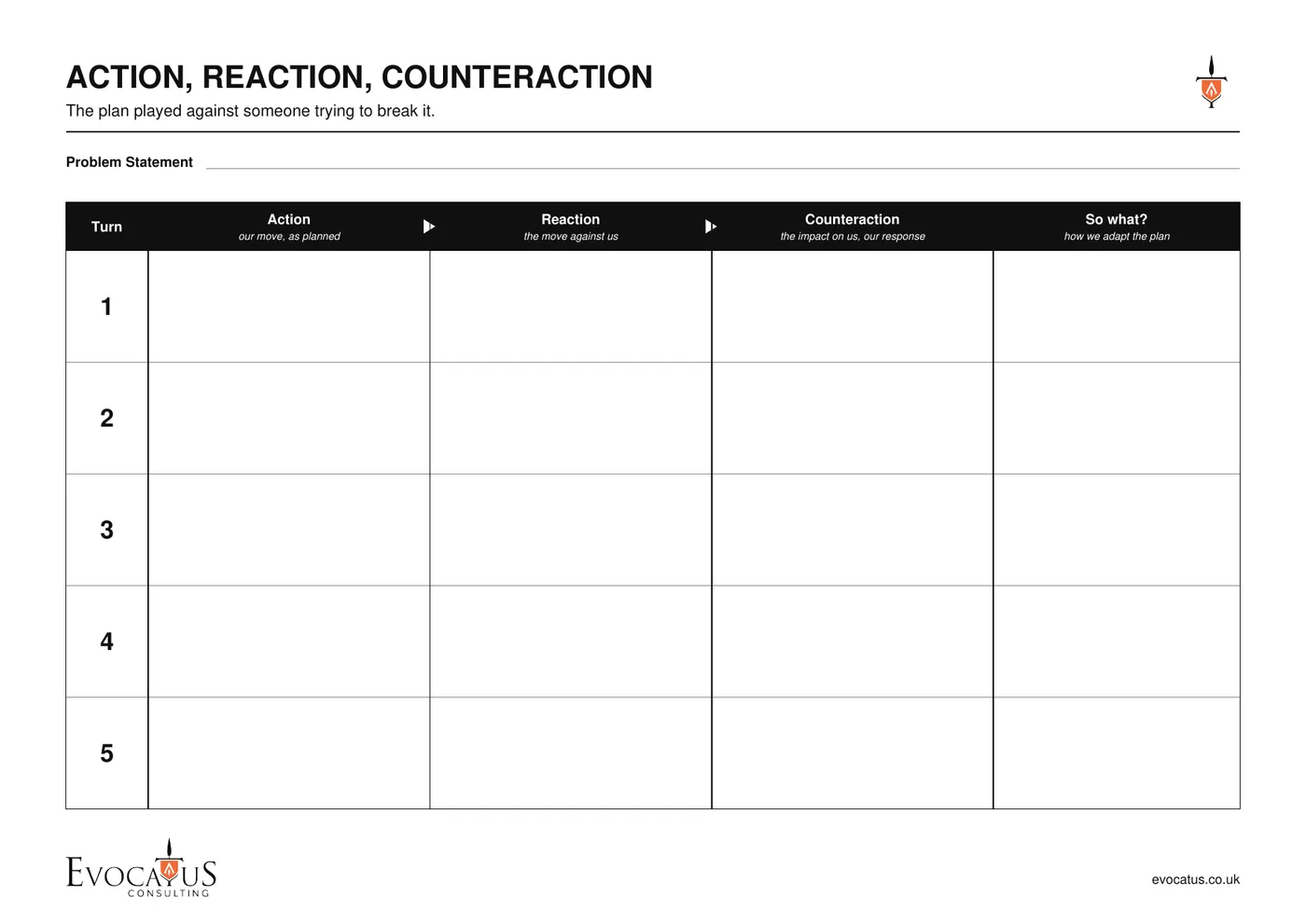
What is a turn? A turn is one step in the plan as it would unfold, rather than a fixed period of time. It might be a phase, such as the launch, the first month or the contract renewal, or a single moment at which the plan depends on something going right. In each turn the plan makes its move, the opposing side responds as it plausibly would, and the team decides how to answer. Five turns cover most plans; if yours has more phases than that, choose the five where the opposition has most to gain.
How to use it. Choose someone to play the opposition and give them time to prepare. The best player knows how the other side thinks and is willing to argue its case. For each turn, state your action, let the opposition give its reaction, then agree the impact and your counteraction. Fill the So what? column at the end of each turn, while the point is fresh. The turn at which the plan breaks is the most useful result the drill can give you, signposting the need to refine it.
Action, reaction, counteraction is the sequence used in course of action wargaming in British and NATO military planning, to test a plan before it is issued.
Download Action, Reaction, Counteraction (A4 landscape PDF)
The sheet arrives by email. The button in that email confirms your address and opens the PDF. You will also receive our newsletter, once a month, from which you can unsubscribe at any time if you don't find it useful.
The Premortem
Why would I use The Premortem?
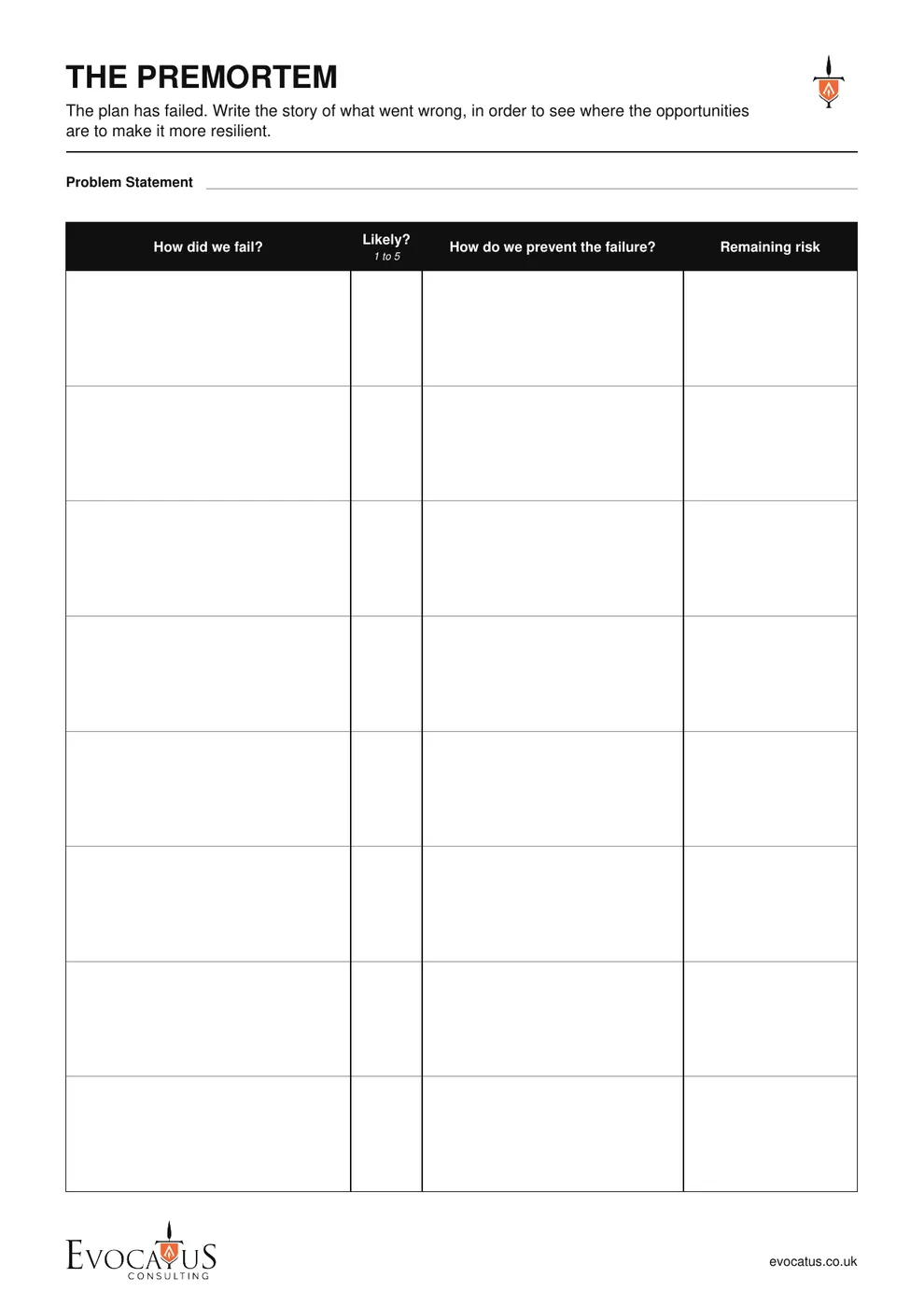
Use it when a plan needs to be refined to make it more resilient. The Premortem asks everyone to imagine the plan has already failed and to imagine why. Because failure is taken as given, people can name the problems they would otherwise keep to themselves out of a sense of loyalty to team and plan.
Ideas first, written alone. Ask each person to write down their own reasons for the failure, silently and separately, before anyone speaks. If discussion starts first, the first or most senior voice tends to set the direction, and the drill’s value comes from the reasons people would not have offered in open discussion. Collect everything, then read the reasons out and group them.
Every phase of the plan. Ask people to consider every stage, from preparation through delivery to handover, and not only the launch. Failures late in a plan are easy to overlook when attention is on getting started.
How to use it. Brief the plan, then tell the team that it is some months later and the plan has failed. Collect the reasons as above and enter them in the first column. Score how likely each is, from 1 to 5, as a group. For each one, agree what would prevent it, and change the plan accordingly. Whatever risk remains goes in the last column.
The premortem (also written pre-mortem) was described by the psychologist Gary Klein in the Harvard Business Review in 2007.
Download The Premortem (A4 portrait PDF)
The sheet arrives by email. The button in that email confirms your address and opens the PDF. You will also receive our newsletter, once a month, from which you can unsubscribe at any time if you don't find it useful.