
Most risk assessment is done in advance and at a desk, by people doing their best to reduce risk before the work starts. Then the work meets conditions that nobody wrote down, and the people delivering it have to decide what to do. Dynamic risk assessment is how a team keeps its freedom of action at that point, and it works best when the factors to watch and the responses to them have been thought through beforehand.
What is a dynamic risk assessment?
A dynamic risk assessment is an activity, done at the point of necessity, which builds on formal risk assessment to identify and respond to emerging risks during a task. It is most effective when potential risk factors and potential responses have been considered in advance.
It is carried out by the people doing the task, while they are doing it. It adds to the written assessment and does not replace it. The second sentence of the definition is the part most guidance leaves out: a team that has already considered what might change, and what it would do about it, assesses faster and better on the day than a team meeting the question for the first time.
Why is dynamic risk assessment important?
Traditional risk assessment is often delivered as a theoretical, office-based activity, with assessors doing their best to manage risk with a focus on bringing it as low as reasonably practicable, but the resulting risk management process can constrain freedom of action for those delivering an activity when something unexpected happens. Dynamic risk assessment builds on that process by empowering teams to make rapid decisions based on the actual hazards they face in the moment.
Without it, a team whose conditions have changed has two poor choices. It can stop and wait for the paperwork to catch up, which costs the task. Or it can carry on under an assessment that no longer describes what is in front of it, which is how people get hurt.
Where dynamic risk assessment comes from
The term comes from the UK fire and rescue service. Firefighters are sent to incidents that no written assessment can describe in detail. A generic assessment covers a house fire or a road traffic collision as a type; the crew then meets one particular building, in specific weather conditions, with or without people still inside. A Fire Service guide published in 1998 set out what experienced officers already did on arrival: evaluate the situation, weigh the risk against what there is to gain, choose a way of working, and keep reassessing as the incident develops. Fire service guidance still describes dynamic risk assessment in those terms, as the assessment of risk in a rapidly changing incident where decisions are made on incomplete or inaccurate information.
Emergency responders deal with specific environmental hazards such as fire, water, weather and unstable structures, and the method was written for them. The same approach applies equally to any team dealing with uncertain situations: an events team watching the weather and the crowd, a site supervisor with a late delivery and fading light, a care team whose resident is not as they usually are.
Dynamic risk assessment and the law
Dynamic risk assessment does not replace the written assessment. Employers in the UK are required to make a suitable and sufficient assessment of the risks of their work and, where they employ five or more people, to record its significant findings. The same regulations require an assessment to be reviewed when there is reason to think it is no longer valid. A dynamic risk assessment is, in effect, that review carried out on the spot by the people best placed to see that things have changed.
The decision is made in the moment. The record follows as soon as the situation allows: what changed, what was decided and why, who decided, and who was told. The fire service builds this in, following the dynamic assessment with a fuller, formally recorded one as soon as time and resources permit. The record does two jobs. It shows an auditor, an insurer or a regulator that leaving the plan was a considered decision, made on what was known at the time. It also feeds what the team learned on the day back into the next written assessment.
A dynamic risk assessment has to have actually been done. Going on gut feel or assumption, without thinking through the hazards, is a bluff, however experienced the person. The thinking can take a minute: what the hazards are, how likely and how severe the harm would be, and what happens if nothing is done. The record made afterwards shows that it took place.
A dynamic risk assessment example
The team running British Army field training in Canada two decades ago used a dynamic risk assessment process to manage complex risk factors in training. The weather and its impact on helicopters for casualty evacuation, the impact of moon state on visibility and the tiredness of the training audience were all among the factors monitored and considered daily, or more often if the pattern of change required it. Increased mitigation was put in place when risk levels were elevated, including pausing movement when an elevated risk of accidents coincided with a no-fly window.
Military commanders in Iraq and Afghanistan used a similar conditions-based approach to make Go/No Go decisions on when to execute operations; these were based on a wider range of factors than just hazards, but the dynamic quality, responding to the situation at the moment of decision, is the same.
In both cases the factors were identified in advance, along with potential responses. What was assessed dynamically was the state of each factor, and whether together they drove a level of risk which went beyond the appetite and tolerance delegated to the commander.
How to carry out a dynamic risk assessment
Most guidance describes a dynamic risk assessment in five steps:
- Identify the hazards present now. They may not be the ones the written assessment listed.
- Judge the chance and severity of harm. Who could be harmed, how likely that is and how severe it would be.
- Weigh the risk against the task. What the task is for, and what happens if nothing is done.
- Decide what to do, and tell the people who need to know. Carry on with more mitigation, change the plan, pause or withdraw.
- Keep reassessing, and record the decision. Reassess as the situation develops; write it down as soon as there is time.
Recording the decision
The Dynamic Risk Assessment Template in our toolkit follows those steps as a record of decision on one page. Each row is one assessment. It records the time and the reason for the assessment, the hazards identified, the chance and severity of harm, the impact of doing nothing, the decision taken, who took it and who was told, and the outcome.
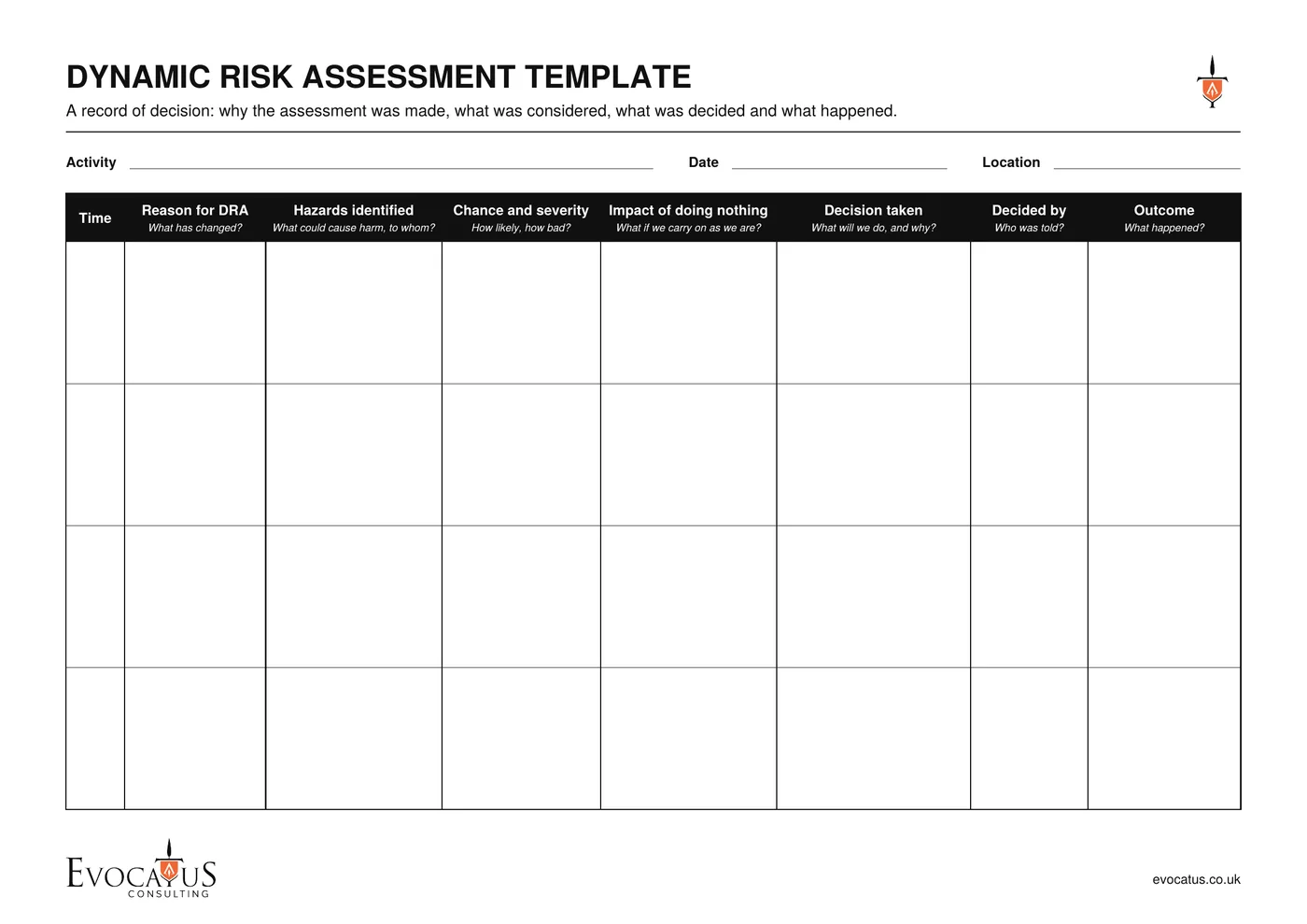
The headings are also the questions to think through at the time. The sheet is filled in as soon as the situation allows, but teams can also use it as a handrail for practising dynamic risk assessments during training and rehearsals.
How we prepare teams to assess risk dynamically
Remembering the process under pressure is the hard part, and the most reliable preparation we know of is to rehearse the activity within an exercise before it happens. Our guide to contingency planning covers how to do that with a tabletop exercise.
A rehearsal flushes out unexpected risk. Taking a team through the task against a realistic scenario, with developments arriving out of order, brings up risks that the desk assessment did not list. Each one found in rehearsal goes into the written assessment and onto the list of factors to watch.
It also closes some of the gap between work as imagined and work as done. A written assessment describes the work as its authors imagined it. An exercise makes the team do the work, against the clock and with incomplete information, and shows where the two differ while the difference costs nothing.
Rehearsal builds orientation, the second step of John Boyd’s observe, orient, decide, act cycle and the one the other three depend on. Orientation is the picture a person forms of what is happening, drawn from what they have been taught and what they have met before. Exercises add to both: they build the team’s skill, and they make likely situations familiar. A team that recognises a situation spends less time working out what it is looking at, so it can assess, decide and act at a tempo that keeps pace with events. We make the same argument about leaders in our article on decision making training.
An exercise is also a good place to practise mission command: telling people what is to be achieved and why, and trusting them with the how, within clear boundaries. A team that understands the purpose of an activity and its priority knows how much risk the activity is worth, which is its risk appetite for the day. A casualty evacuation justifies more risk than a routine move. Without that understanding, every dynamic assessment falls back on the most cautious answer, or waits for someone senior.
The formal risk assessment produced in a comfortable office still has to be done. Rehearsal prepares the team for the moment events depart from it, and gives its people confidence in the freedom of action they have to deal with it. We design and run these rehearsals as part of our resilience work.
Frequently asked questions
What is a dynamic risk assessment?
An activity, done at the point of necessity, which builds on formal risk assessment to identify and respond to emerging risks during a task. It is most effective when potential risk factors and responses have been considered in advance.
What are the five steps of a dynamic risk assessment?
Most guidance gives five steps, sometimes called the five key areas. Identify the hazards present now; judge who could be harmed, how likely that is and how severe it would be; weigh the risk against what the task is for and what happens if nothing is done; decide what to do and tell those who need to know; keep reassessing, and record the decision as soon as there is time.
When should a dynamic risk assessment be carried out?
Whenever conditions during a task differ from those the written assessment anticipated, and at agreed intervals where known risk factors such as weather, light or fatigue are being monitored.
Is a dynamic risk assessment a legal requirement?
The law requires a suitable and sufficient risk assessment, kept under review, with the significant findings recorded where five or more people are employed. A dynamic risk assessment is how that duty is met when the emerging situation differs from the one assessed. It does not replace the written assessment.
What are the four types of risk assessment?
The common list is qualitative, quantitative, generic and site-specific, with dynamic risk assessment sometimes added as a fifth. In practice the useful distinction is simpler: the written assessment anticipates, and the dynamic assessment responds.
What is a dynamic risk assessment in moving and handling?
In health and social care, the written moving and handling assessment covers the usual transfer of a particular patient. The dynamic assessment is the carer’s judgement when today differs: the patient is in pain, the hoist is unavailable, a second carer has not arrived. The decision may be to proceed differently, to wait, or not to move the patient at all.
Does a dynamic risk assessment need to be written down?
The assessment is made in the moment. It should be recorded as soon as the situation allows: what changed, what was decided and why, who decided and who was told. The record shows that the decision was considered, and it informs the next written assessment.